
A National Horological Network
French clockmaking developed through complementary regional centers. Paris specialized in precision, luxury cases, public clocks, marine chronometry, and finishing; Morez and Morbier produced Comtoises and monumental clocks; Beaucourt mechanized components; Saint-Nicolas-d'Aliermont specialized in alarms and small movements; Besançon and other centers supplied watches, components, tools, springs, pinions, and unfinished mechanisms.
Illustrated record
Luxury and Mass Production Coexist
Parisian clocks could be collaborative works of decorative art involving movement makers, bronze founders, enamelers, cabinetmakers, and sculptors. At the opposite end of the market, Japy and Bayard demonstrated large-scale mechanized production of inexpensive movements and alarms. France could operate at both extremes.
Morez and Distributed Industrialization
The Morez region achieved factory-scale output through specialized household labor even before centralized factories dominated. Standardized components and merchant coordination pushed annual Comtoise production above 100,000 by the mid-nineteenth century. Later, factory districts, foundries, enamel shops, and public-clock firms made the region a complex industrial ecosystem.
Illustrated record
The Missing Ingredient Was Demand
The scarcity of French chess clocks cannot be explained by a lack of mechanical expertise. The technology needed for chess timing—alarm movements, cases, hands, springs, dials, small mechanisms—was abundant. The problem was market size. France's great era of chess leadership at the Café de la Régence largely preceded the 1883 chess clock, while twentieth-century federation membership remained comparatively small.
Illustrated record
The trade data are important because they argue against an industrial-capacity explanation for France’s sparse chess-clock record. France exported 17.4 million francs of horological goods in 1875 and about 20 million francs in 1898. Adjusting the nominal 1928 figure to roughly prewar-franc equivalents produces about 16.45 million francs of exports against approximately 19.48 million francs of imports. French horology had not disappeared; by 1928 the country was increasingly reliant on imported horological goods and components while retaining substantial technical capacity. The scarcity of French chess clocks is therefore better explained by the limited specialist chess market than by an inability to manufacture clocks.
French Chess Prestige Without Mass Organization
France created FIDE in Paris and maintained enormous historical prestige, but the federation had only about 30 official clubs and 1,500 licensed members in the late 1920s, and membership remained near 2,000 in the 1950s. That formal competitive market was too small to encourage many specialized chess-clock lines when imports were readily available.
French Chess Retains Prestige Without Building a Mass Organization
Duverdrey & Bloquel / Bayard
A wooden French clock using Duverdrey & Bloquel/Bayard-family alarm movements shows one production path: standardized domestic clock units installed in a purpose-built chess case. A later dedicated Bayard-branded chess clock makes the chess identity explicit. Together they suggest continuity without proving one uninterrupted factory model line.
Illustrated record
Delaire and German Mechanics
Henri Delaire was a central French chess organizer and equipment seller. A Delaire-branded wooden clock appears to use German Junghans mechanics, combining Paris chess commerce with imported movement technology.
Besançon and Unidentified Assemblies
Another wooden clock carries Besançon markings and an unidentified LGA/DLGA-style logo, with jeweled French movements. An unidentified prewar clock uses square French alarm units. These objects reinforce the same pattern: purpose-built cases assembled around standardized small timekeeping units.
Unidentified French Pre-War Chess Clock
Square Alarm-Clock Units in a Wooden Case
This pre-WWII French chess clock uses two square “Made in France” alarm-clock units mounted into a dark wooden tournament case. Its rounded square bezels, Art Deco-style numerals, red fall flags, and rear “modèle déposé” type markings place it within the same 1930s French alarm-clock vocabulary seen in documented French square clocks of the period. The maker remains unidentified, but the clock is useful as another example of the French wooden-case tradition: standardized domestic clock units adapted for chess timing.
Illustrated record
Historical Sequence
France's story is one of capability without a mass specialist market. The country supplied world-class mechanics and manufacturing systems, but organized chess demand was too modest to sustain a Germany-style chess-clock industry. The resulting clocks are fewer, more heterogeneous, and often best understood as assemblies built from the country's broader horological economy.
Explore this national record
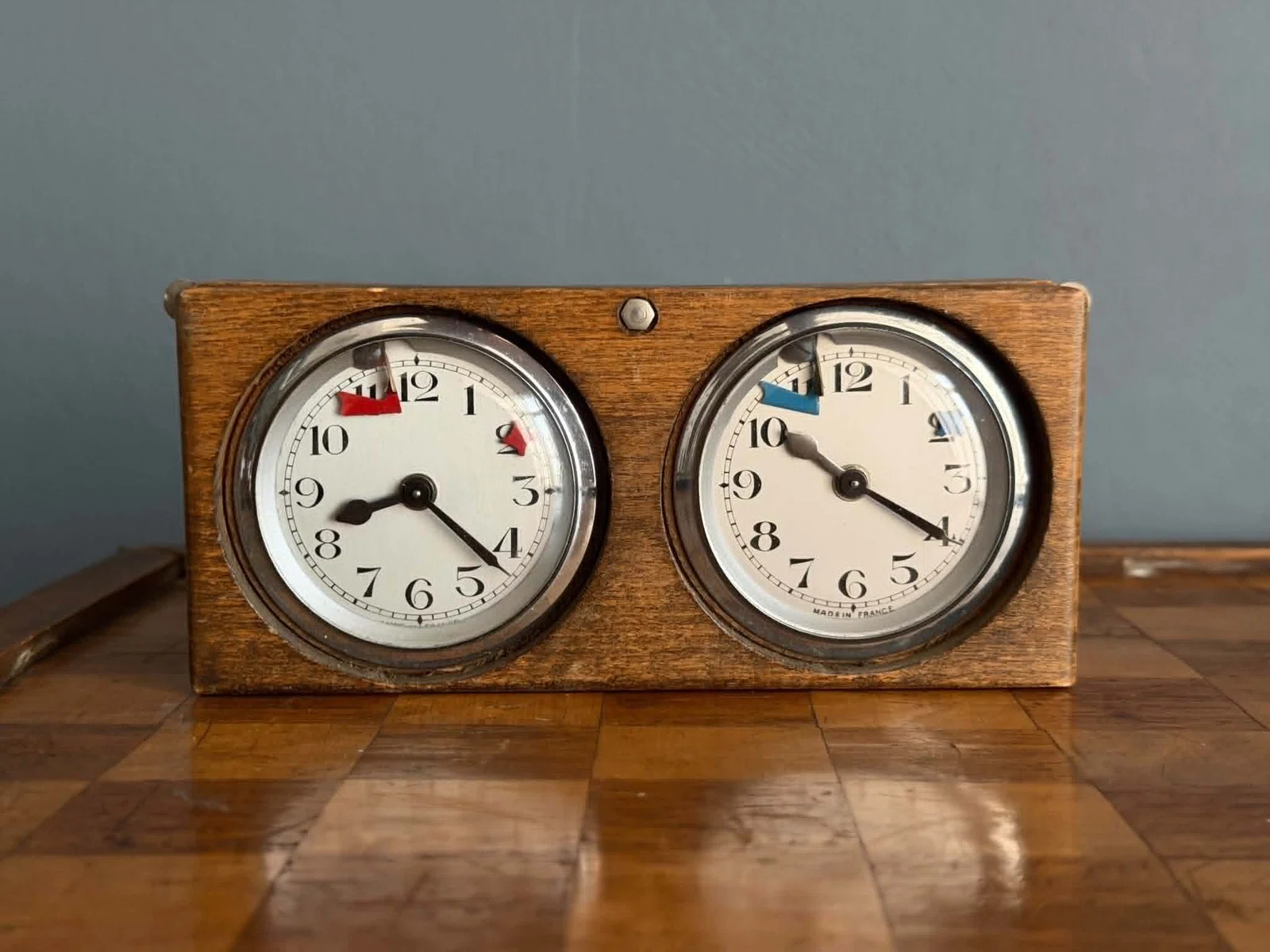
Duverdrey & Bloquel / Bayard
A cautious French lineage connecting major alarm-clock manufacturing to both a wooden movement-based chess clock and a later explicitly Bayard-branded tournament timer.
Read the History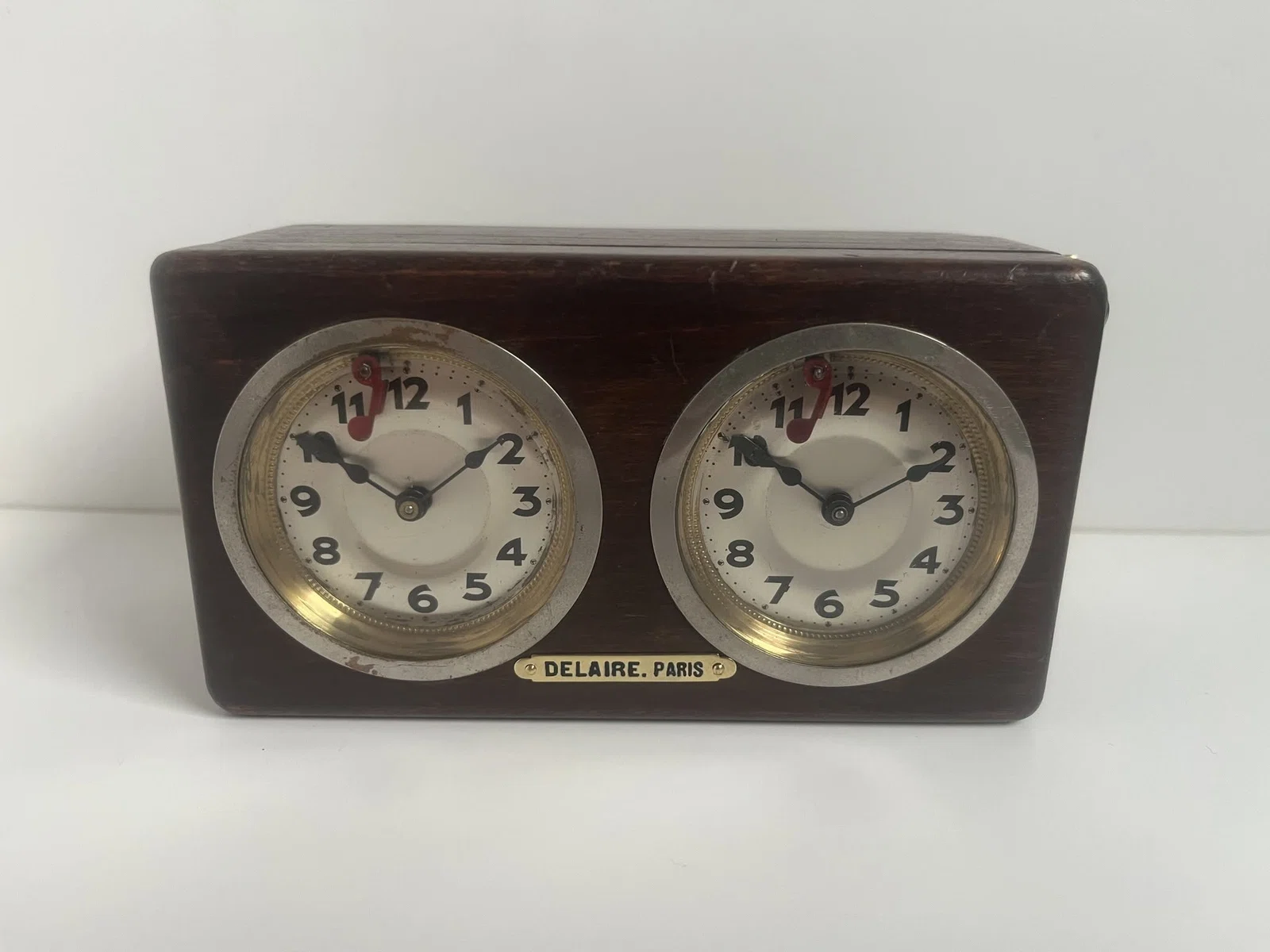
Delaire, Paris
A French chess supplier's branded clock that appears to combine Parisian commercial identity with German Junghans mechanics.
Read the History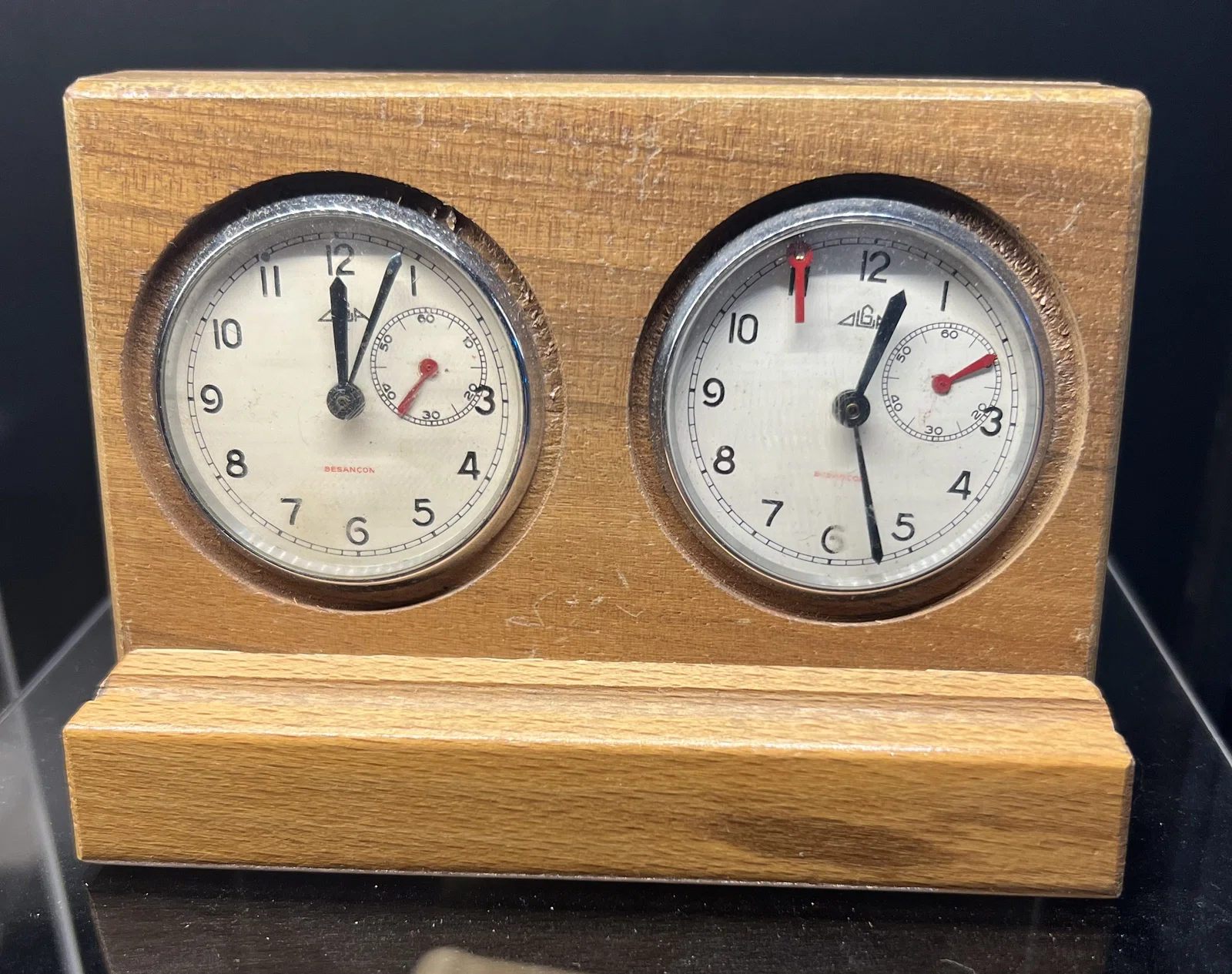
Besançon / Unidentified LGA Mark
A French wooden chess-clock assembly whose jeweled Besançon-linked mechanisms preserve regional horological identity without revealing the complete maker.
Read the History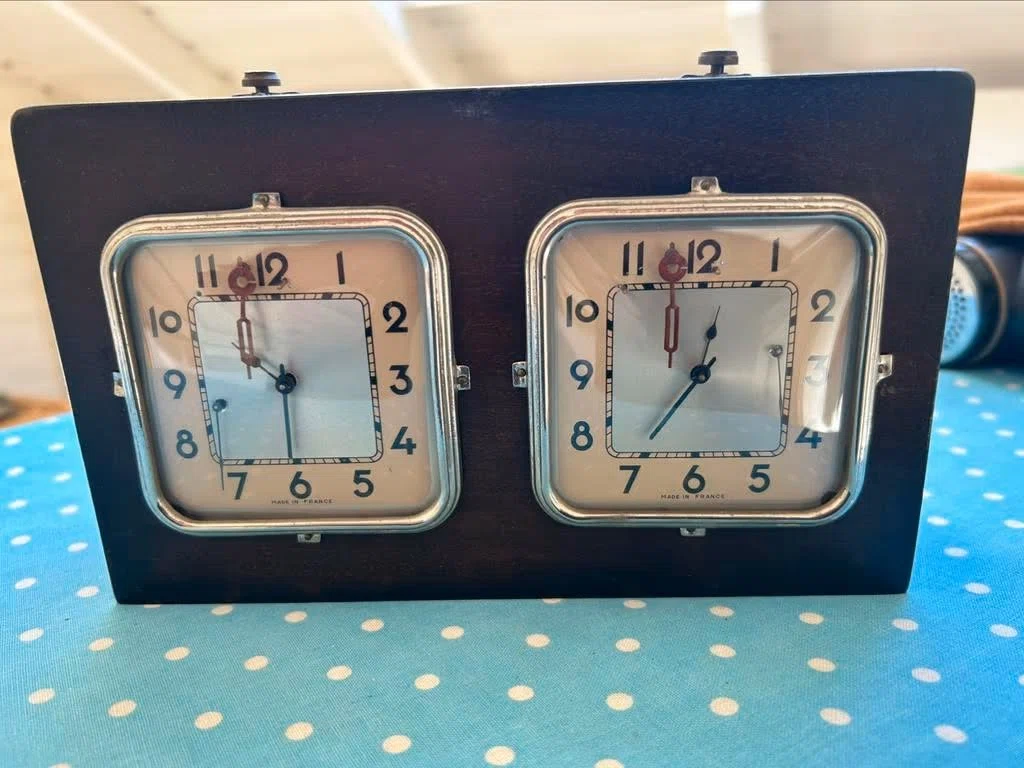
Unidentified French Pre-War Chess Clock
A 1930s-style tournament clock built from two square French alarm-clock units in a wooden case, with the complete maker still unknown.
Read the History