
An Early Watchmaker-Centered Clock
The Carl Jonsén / F. O. Carlsson clock represents the earliest stage currently documented here. Jonsén, a Swedish-born Copenhagen watchmaker, took over F. O. Carlsson's business in 1897. A surviving clock bearing the successor firm's plaque is collector-dated broadly to the early twentieth century.
Illustrated record
1930s Club Demand Creates Named Products
By the 1930s Danish chess had enough organized demand to support clearly advertised domestic timers. Gudmund Veng introduced the DAN in 1934 after requests from prominent chess figures. Th. Sandorff advertised the FIX later that year. Victor Krebs introduced the Olympia in 1938 from his Nakskov workshop.
Illustrated record
Imported Movements, Danish Finished Clocks
Krebs's Olympia provides direct internal evidence: the movements carry the crossed-arrows trademark of the German Hamburg American Clock Company. Contemporary advertising nevertheless states that the clock was manufactured in Krebs's own workshop. This is a classic layered product—German mechanics inside a Danish finished timer.
Victor Krebs / “Olympia” - A Danish Chess Clock with German Movements
Competition and Commercial Differentiation
DAN emphasized compact dimensions, cabinetmaking, precise switching, quantity discounts, and formal design protection. FIX emphasized polished mahogany and first-class workshop craftsmanship. Olympia offered several woods, a guarantee, running indicators, flags, and introductory pricing.
Historical Sequence
Denmark's clocks show multiple production paths coexisting in a relatively small market: established watchmakers, purpose-designed club equipment, direct workshop sale, imported movements, and documented prize use.
Explore this national record
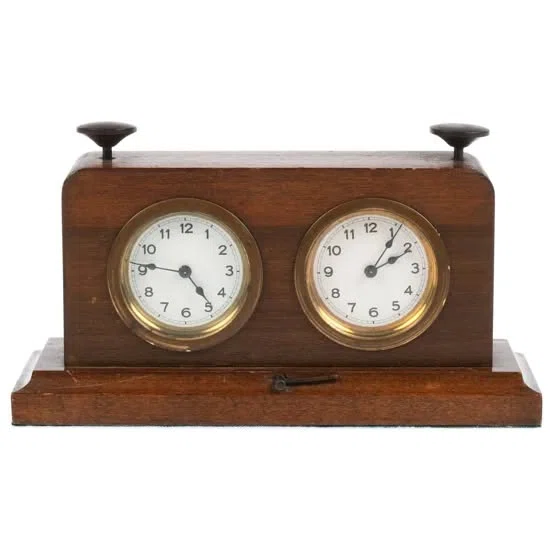
Carl Jonsén / F. O. Carlsson
An early Copenhagen chess clock whose business plaque is secure while the exact manufacturing role behind the finished object remains open.
Read the History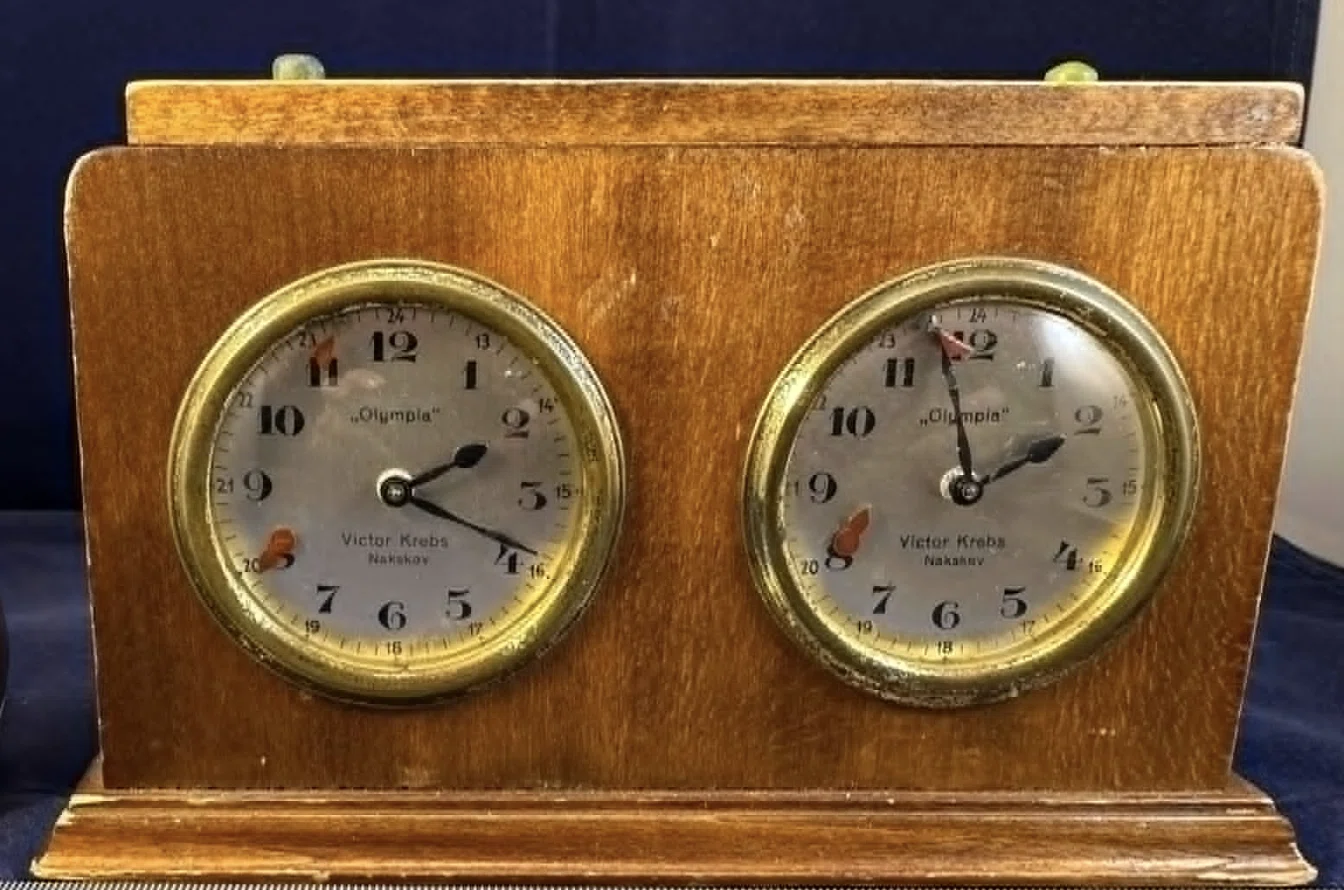
Victor Krebs / Olympia
A late-1930s Danish workshop clock whose German HAC movements and dated prize plaque make its construction and competitive use unusually traceable.
Read the History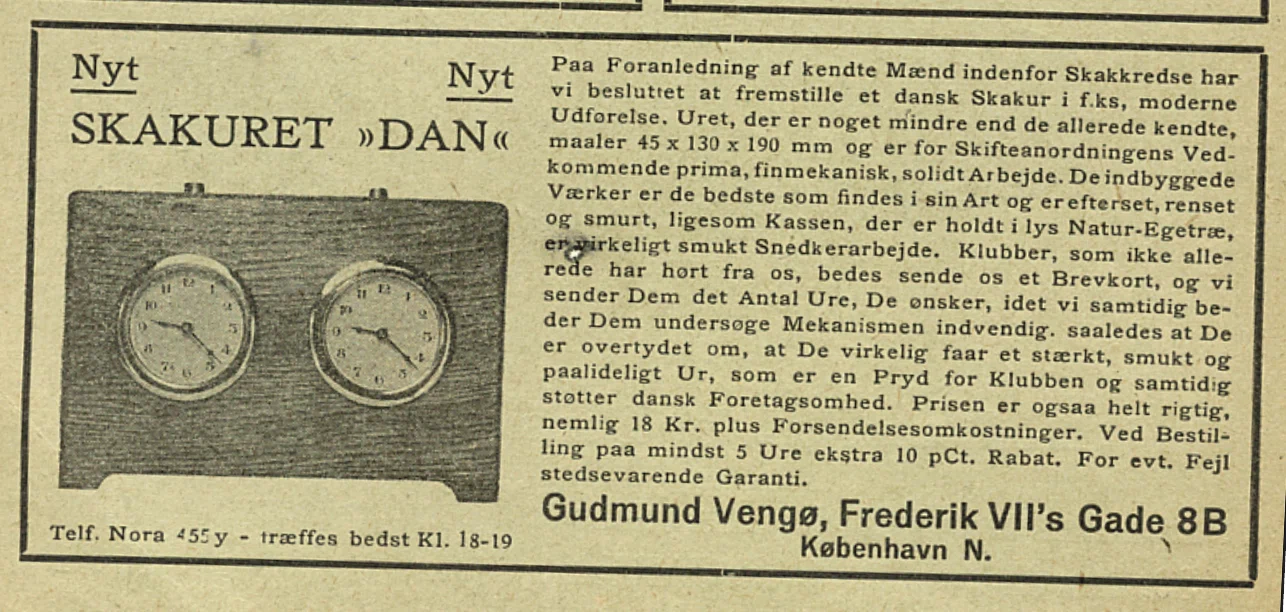
DAN
A compact 1934 Danish club clock that quickly moved from local introduction to protected design and wider commercial distribution.
Read the History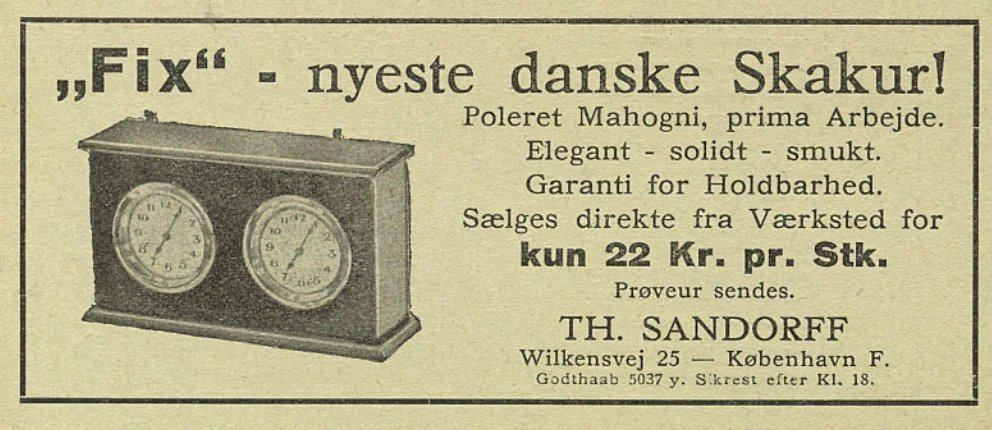
FIX
Th. Sandorff's 1934 mahogany clock offered a craftsmanship-oriented alternative to Denmark's more utilitarian club products.
Read the History