
A Horological Power Before Chess Needed a Clock
The British chess-clock story begins long before anyone tried to measure a player's thinking time. By the late seventeenth and early eighteenth centuries, English watchmaking had become one of Europe's leading precision crafts. The balance-spring breakthrough, skilled metalworking, and a dense network of specialist trades created an industry capable of making complex timekeepers at scale by the standards of the period. From 1710 to 1809, the available estimates suggest that real watch prices fell by about 1.3 percent per year, or roughly 75 percent across a century. By the late eighteenth century, English output was around 200,000 watches annually, approximately half of European production.
That scale did not come from a modern integrated factory. British horology was organized as a web of specialists: dial makers, spring makers, pinion makers, movement makers, finishers, toolmakers, case makers, and other tradesmen whose work converged in a finished object. London and Clerkenwell were major centers, joined by Prescot and Lancashire, Coventry, and Birmingham. The system produced immense accumulated skill. It also created a structural weakness that would become more important as the nineteenth century progressed: excellence was distributed across many specialized workshops rather than concentrated in standardized factory production.
Illustrated record
The Industrial Paradox on the Eve of 1883
By the time the chess clock appeared, Britain still possessed prestige, skilled labor, and established retail channels, but the international clock and watch industry was changing around it. Swiss firms increasingly competed on price. From the 1850s, American manufacturers pushed machine production, standardization, and interchangeable parts. German clockmakers were also building the industrial base that would later supply inexpensive, reliable movements in enormous quantities.
Apprenticeship evidence illustrates how specialized the older British model had become. In Lancashire, the share of apprentices described simply as “watchmakers” fell from 48.9 percent before 1750 to 20.5 percent in 1780–1809 as the trade fractured into narrower occupations. That specialization had once been a source of strength; in an age increasingly driven by uniform components and high-volume production, it made rapid modernization more difficult.
This is the setting in which the first British chess timers emerged. They were not the products of an industry beginning a new mass-production boom. They came from a mature craft culture that still knew how to build sophisticated mechanisms, even as Britain was beginning to lose the lower and middle portions of the wider timekeeping market.
England’s Clock & Watch Industry on the Eve of the Chess Timer
The rising number of watch- and clockmakers—from 14,779 in 1841 to 25,903 in 1881—shows the depth of Britain’s horological labor pool immediately before Wilson’s 1883 timer. But the headcount should not be mistaken for a new integrated-factory boom. British production still relied heavily on specialist handwork, subcontracting, and outwork while Swiss makers competed on price and American firms advanced machine production and interchangeable parts. The first chess clocks therefore emerged from a large, skilled, mature craft system that was already under industrial pressure.
1883: Thomas Bright Wilson Makes Timed Chess Practical
The decisive step came at the London tournament of 1883. Thomas Bright Wilson's practical chess clock placed two mechanical clocks side by side and linked them so that only one ran at a time. After moving, a player operated the control and transferred the burden of time to the opponent. The surviving prototype shown in surviving documentation is visibly improvised, using repurposed mechanical components, but its importance lies in the system rather than its polish.
Wilson's device solved the central problem that sandglasses and manually operated stopwatches had not solved elegantly: it let the players themselves control alternating time without requiring an arbiter to supervise each board continuously. It also made losing on time a practical and enforceable part of competitive chess. The basic idea was successful enough to spread rapidly through European tournament play.
The first design was still primitive compared with later clocks. Synchronization between the two mechanisms could be imperfect, and the device had none of the later complexity associated with multiple time controls, delay, or increment. But the essential architecture had arrived. Chess time was no longer merely recorded. It had become part of the game.
Invented in 1883 by Thomas Bright Wilson
A Prestigious Instrument, Not Yet Everyday Equipment
Early chess clocks were expensive enough that the new technology did not immediately become ordinary equipment for every player. Jaques pricing illustrates the barrier: timers offered at 21 to 24 shillings represented roughly 1.5 to 1.7 percent of a worker's entire annual income. Using the modernized purchasing-power comparison adopted here, that corresponds to a price of roughly £573 to £675, or about $763 to $898, for a single clock.
That cost existed in a world where food and housing consumed the overwhelming majority of many household budgets. The available estimates suggest that discretionary income for most workers was likely well under 10 percent of gross wages. A chess timer therefore belonged most naturally in clubs, organized competitions, and affluent private settings. Timed chess had been technologically enabled, but access to the equipment remained socially uneven.
The famous Hastings tournament of 1895 belongs to this environment: international chess was becoming more organized and more visible, yet much of the equipment surrounding serious play still carried the economics of an elite pastime.
Chess Was Still A Pastime For The Elite
From Invention to a Market
The years after 1883 transformed the chess clock from a clever solution into a recognizable product category. Fattorini & Sons developed early commercial clocks rooted in high-skill metalwork and pendulum mechanisms. Jaques of London turned tournament timing into branded prestige equipment and repeatedly offered recognizable models to the chess market. The British Chess Company entered as a specialized challenger during a period of rapidly expanding club chess.
Demand was genuinely growing. Contemporary evidence suggests that the number of London chess clubs roughly tripled between the late 1880s and the end of the century, while provincial clubs grew from about 180 in 1887 to roughly 420 in 1897. That expansion mattered because chess clocks made the most sense in precisely these institutional environments. A club could absorb the cost of specialized equipment in a way that an ordinary household often could not.
Yet the market was still not mature in the modern industrial sense. The important clocks of the late nineteenth century remained rooted in craftsmanship, specialized assembly, and relatively limited production. Even the rise of recognizable brands did not mean that Britain had discovered a scalable domestic chess-clock factory system.
Illustrated record
The Mechanical Heart Begins to Travel
The next stage is one of the most important themes in British chess-clock history: British identity and British manufacture were not always the same thing. Jaques Congress Timers increasingly show German Hamburg American Clock Company movements inside British casework and controls. William Tanner's “Reliable Chess Timer” likewise used HAC movements marked “Made in Wurttemberg,” with the finished clock assembled and sold through a British retailer.
This was not a failure of chess-clock design. It was a change in industrial organization. Germany could supply standardized mechanical movements efficiently, while British firms and retailers contributed casework, switching systems, branding, assembly, distribution, and access to the chess market. The finished object could be unmistakably British in commercial and cultural identity even when its mechanical heart was imported.
That layered identity would become a recurring theme across the worldwide history of chess clocks. The name on the dial, the maker of the movement, the assembler of the case, the retailer, and the country where the clock entered tournament life could all be different.
Illustrated record
Industrial Scale Finally Arrives
By the interwar period, British chess timing moved closer to the industrial model that had been missing from the earliest years. Enfield Clock Company, founded in 1929, according to the underlying source chronology, became a major producer of standardized mechanical clock movements. In chess clocks, those movements supported the familiar twentieth-century architecture: two independent mechanisms in a shared case, controlled by push buttons and built from components intended to be repeatable rather than individually fitted.
This was a fundamental shift. A movement no longer had to be treated as the bespoke heart of one instrument. It could be produced as a standardized component and used across many clocks. The result was greater consistency, reliability, and availability. Chess clocks could spread beyond prestige events and specialist makers into the ordinary infrastructure of club and tournament chess.
The Smiths/Enfield manufacturing network and the clocks associated with Sutton Coldfield pushed this transition further. Sold through established chess channels including CHESS magazine and the British Chess Federation, Sutton Coldfield clocks represent the point at which the chess clock became routine equipment. The technology was no longer exotic. It had become part of organized chess life.
Illustrated record
A Late British Experiment: The Horizon
By the 1980s, the basic purpose of the chess clock had long been settled, but British experimentation had not entirely disappeared. James Baillie's Horizon approached the problem from an unexpected direction. Instead of changing how time was measured, Baillie changed how the clock was physically presented.
The Horizon placed two quartz dials face-up beneath a clear Perspex cover so they could be viewed from above. According to the surviving family recollections, the design was intended to make chess clocks easier to film during championships. Baillie assembled the clocks at home in Sale, Cheshire, with family members helping on small tasks; early Perspex pieces were reportedly bent over an electric fire.
The Horizon is therefore a fitting late chapter in the British story. The first British clocks had solved the problem of alternating time. A century later, a home workshop was reconsidering the clock for the age of tournament photography and broadcasting.
Horizon – A British Horizontal Chess Clock
The Decline of British Horological Dominance
Britain's importance to chess timing should not be confused with continued dominance of the wider clock industry. The long decline is best understood as the result of foreign industrial competition rather than an absence of horological skill. Switzerland attacked lower-cost watch markets; the United States pioneered factory production and interchangeable parts; Germany expanded clock output into the millions.
The trade data makes the shift visible. Between 1869 and 1909, British clock exports were essentially flat to lower in unit terms while imports rose from about 300,000 to 2.34 million. The value per imported clock fell dramatically—from roughly £0.97 to £0.18 in the chart—while the value per exported clock edged upward. In other words, imported clocks became vastly cheaper while British exports remained relatively expensive.
For chess clocks, this helps explain the historical trajectory from British invention and prestige toward imported movements, consolidation, and eventually imported finished products. Britain remained central to the cultural and commercial history of the chess clock, but the economics of mass mechanical timekeeping increasingly favored industrial producers elsewhere.
Illustrated record
British Chess Clocks as a Historical Sequence
The British story is not a simple procession of better mechanisms. It is a sequence of changing production systems. Wilson represents practical invention. Fattorini represents skilled early adoption. Jaques represents commercial standardization and prestige branding. The British Chess Company represents emerging competition in a growing chess market. Tanner represents regional assembly using imported industrial movements. Enfield and Sutton Coldfield represent factory standardization and mass club use. Horizon represents late small-scale experimentation after the basic technology had matured.
Taken together, they show why Britain occupies such an important place in chess-clock history. The country did more than produce several notable clocks. It helped define the device, turn it into recognizable tournament equipment, and then reveal—through its own changing industrial structure—how chess clocks would become international products built from increasingly global supply chains.
Illustrated record
Further visual record
Additional surviving objects, documentary images, advertisements, and data from this national history.
Illustrated record
Explore this national record
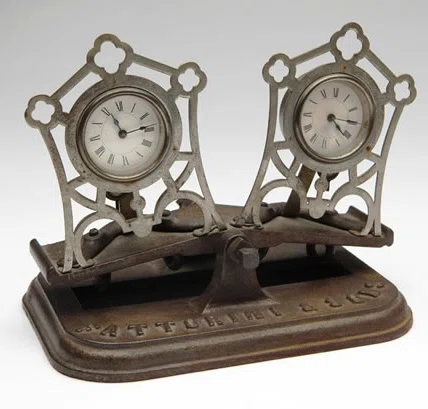
Fattorini & Sons
An early British maker that carried the chess clock from experimental invention toward commercial tournament equipment while remaining rooted in high-skill craft production.
Read the History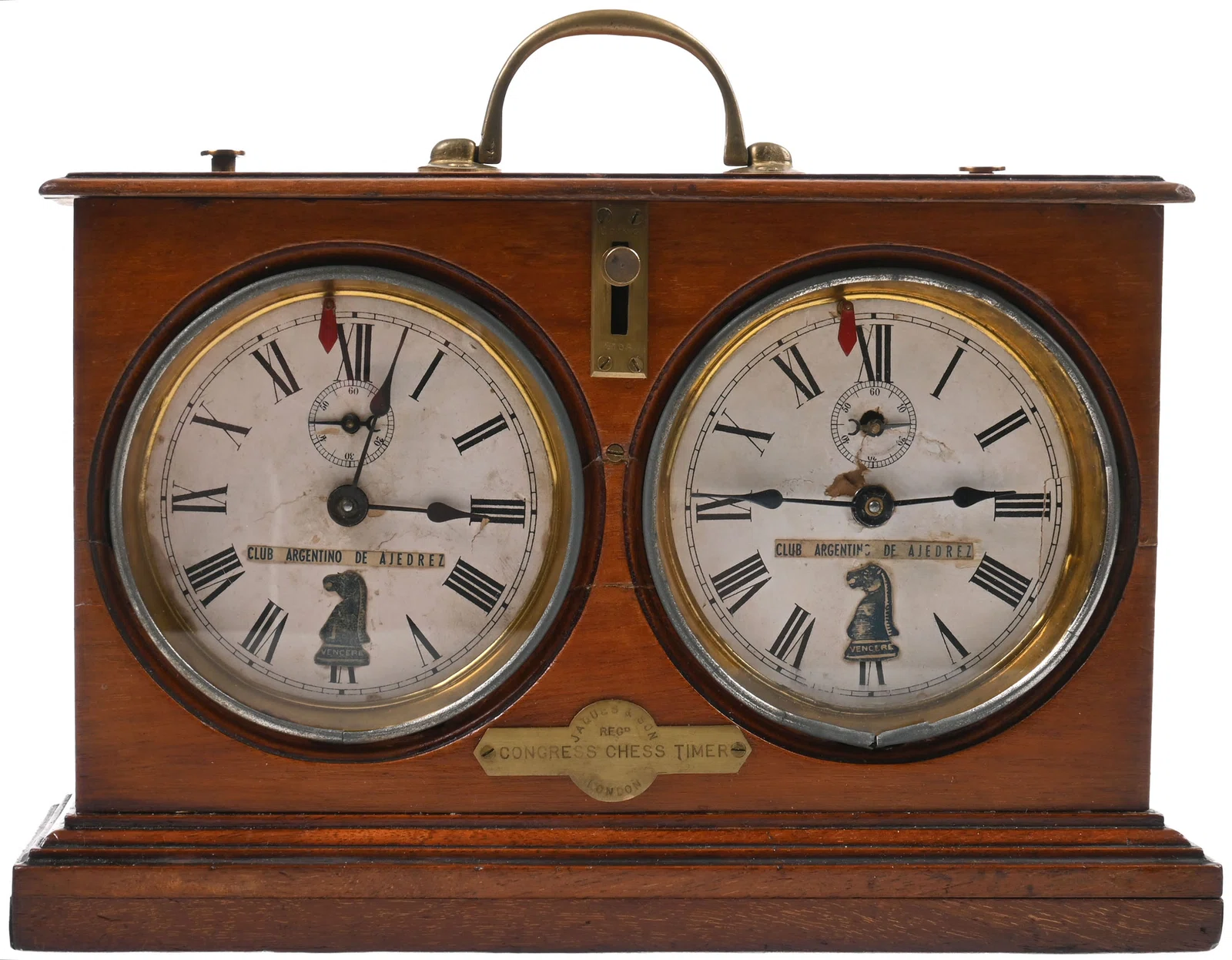
Jaques of London
Jaques did not merely sell chess timers. It helped turn them into recognizable, repeatable tournament instruments—extending the firm's earlier role in standardizing the physical language of serious chess.
Read the History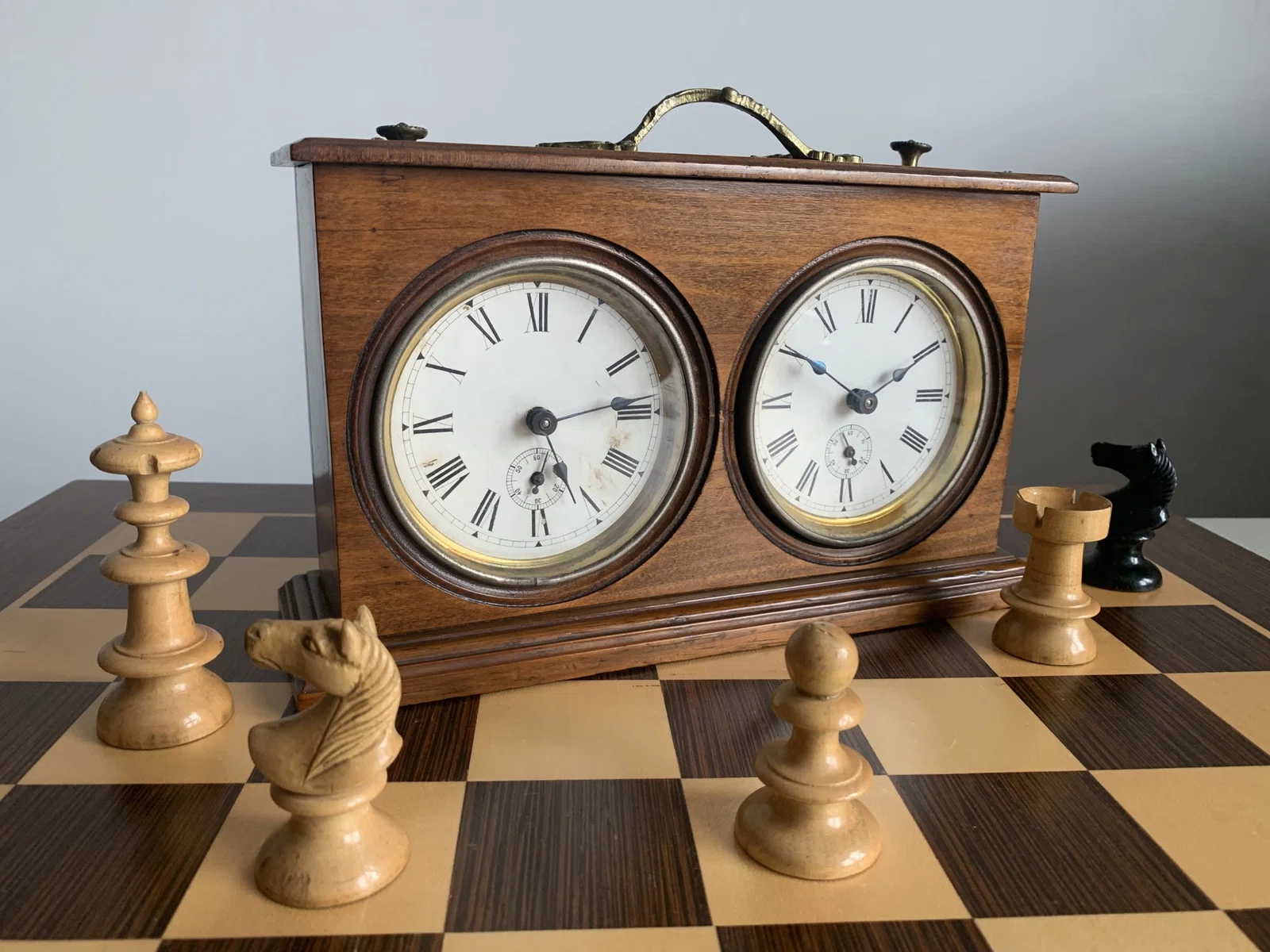
British Chess Company
A short-lived specialist challenger to Jaques that emerged as British club chess expanded and experimented with materials, manufacturing shortcuts, and a more focused chess-goods identity.
Read the History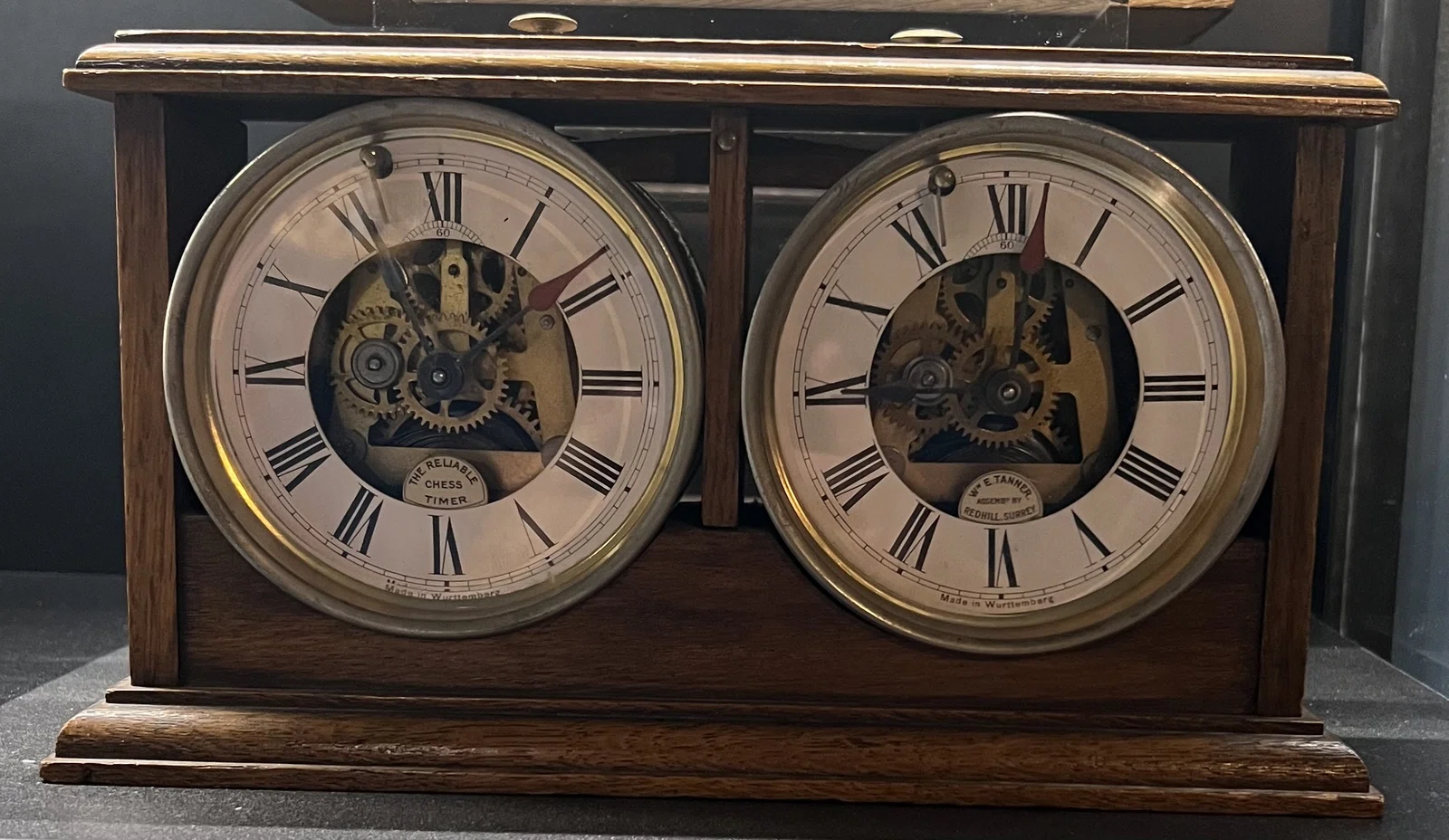
William Tanner
A regional British retailer whose 'Reliable Chess Timer' illustrates the shift from maker-built clocks to finished products assembled around imported industrial movements.
Read the History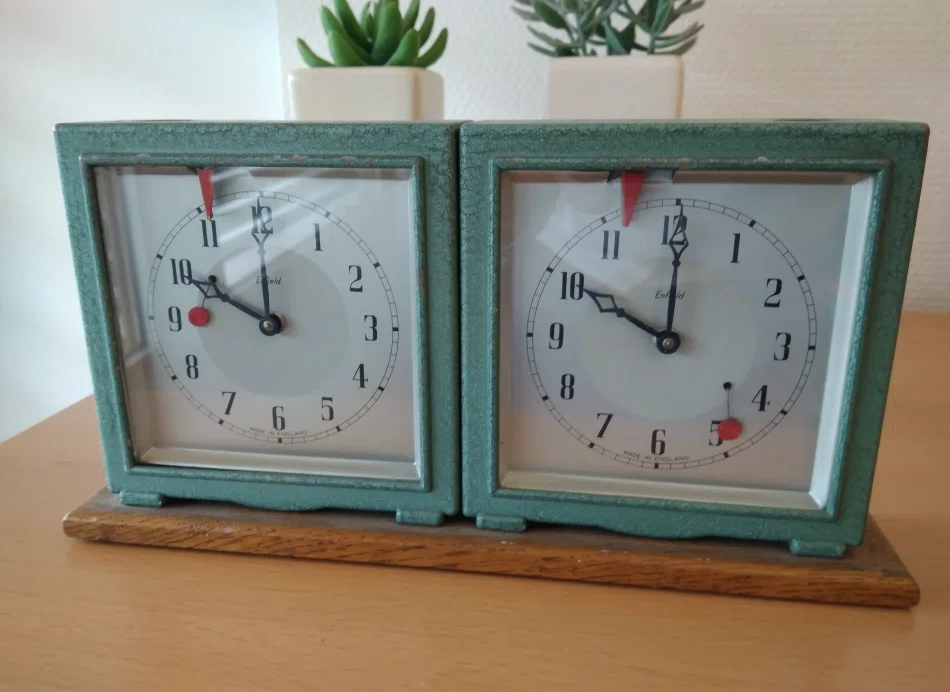
Enfield Clock Company
Enfield marks the point at which standardized factory clock movements made British chess clocks more reproducible, consistent, and scalable.
Read the History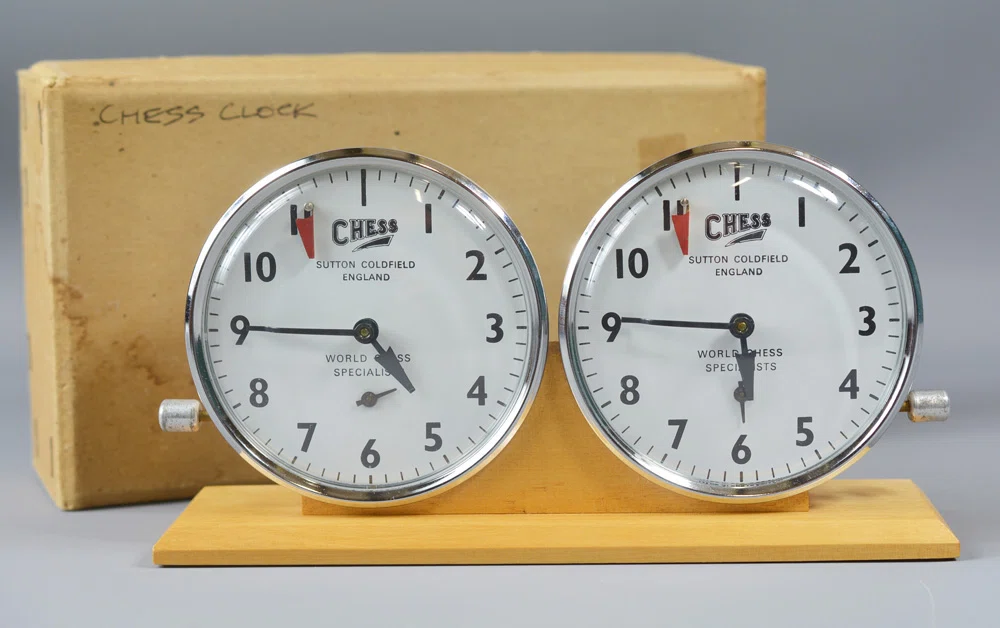
Sutton Coldfield Chess Clocks
More a regional and institutional identity than a single company, Sutton Coldfield clocks show the chess clock becoming ordinary club equipment inside Britain's mature industrial manufacturing system.
Read the History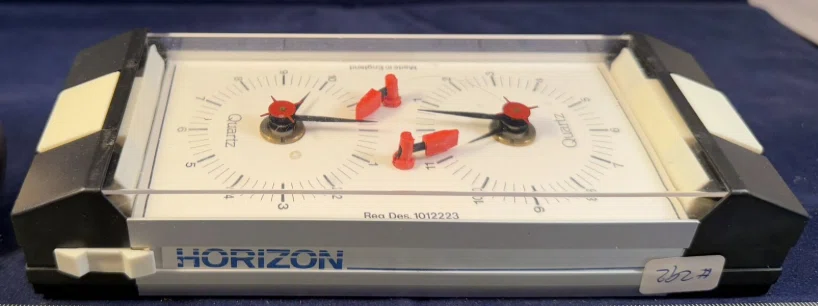
Horizon
A small-series British quartz clock that reconsidered not the measurement of chess time, but the physical orientation of the clock for an emerging broadcast environment.
Read the History