
A Thousand Years of Chess
The Versus de Scachis manuscript at Einsiedeln, dating to about AD 997, places Switzerland among the earliest documented European centers of chess. Zurich's chess society, founded in 1809, became the oldest continuously operating chess club in the world, and Swiss tournament culture later contributed the pairing system that made large open events practical.
Early Swiss Chess History
The Swiss System and Tournament Organization
The pairing method associated with Julius Müller and formally linked with the 1895 Swiss Championship solved a logistical problem central to mass tournament chess: how to run a large event in a fixed number of rounds without eliminating participants. Swiss chess therefore contributed not only players and clubs but an organizational technology still fundamental to tournament life.
Illustrated record
Precision Rather Than a German-Style Clock Empire
Swiss horology grew from Geneva and the Jura into a vast export industry. By 1927 Switzerland exported more than 18.5 million watches and movements, and postwar output climbed even higher. Yet the industrial culture remained strongly associated with small precision mechanisms, specialized labor, and watchmaking expertise. Swiss chess clocks should therefore be read through compactness, refinement, and movement quality as much as through production volume.
Illustrated record
Employment and export value show the same transformation from another angle. Watchmaking grew from hundreds of workers in eighteenth-century Neuchâtel to tens of thousands nationally, with factory work and decentralized home production continuing side by side. Postwar watch exports rose from under CHF 500 million in 1945 to more than CHF 3 billion by 1974. Chess clocks were a tiny specialist product within that economy, but their makers benefited from an unusually deep ecosystem of skilled labor, precision mechanics, suppliers, and export channels.
The production and export figures show the extraordinary scale behind Swiss chess timing. Geneva was exporting more than 60,000 watches by about 1790 while the Jura region produced roughly 50,000 per year; Jura output reached about 100,000 by 1817. By 1927 Switzerland exported more than 18.5 million watches and movements, and export volume reached roughly 84 million pieces in 1974. Swiss chess clocks therefore emerged inside an industry already optimized for precision, miniaturization, component supply, and international distribution.
Birse Brings Swiss Precision to Tournament Chess
Birse-Clock / Court Watch Co. movements formed the basis of 'Grob's Schachuhr,' advertised in 1948 and documented at Lucerne that year and the Dubrovnik Olympiad in 1950. Its jeweled alarm-clock movements and compact wooden case applied Swiss precision to an already-established chess-clock architecture.
Illustrated record
Solora Miniaturizes the Device
Solora went further by using wristwatch- or pocket-watch-sized movements inside a precisely cut wooden block. The result was unusually small and quiet. Swiss manufacture could then travel through foreign distribution channels, including H. Koopman in the Netherlands, while retaining its Swiss mechanical identity.
Illustrated record
Workshop Experimentation and Luxury Branding
E. Breitinger represents the opposite end of the scale: a rare Zurich-area watchmaker clock marked 'Patent angemeldet,' known mainly from surviving examples. Heuer/Looping later moved Swiss chess timing toward premium branded design, combining compact tournament function with refined materials and the prestige of a major sports-timing name.
Illustrated record
Retail Distribution
J. Briner of Zurich demonstrates the commercial layer. Briner sold chess equipment broadly and applied his business identity to clocks without clear evidence that he manufactured them. Swiss timing history therefore includes the same distinction seen elsewhere between the clockmaker, the brand, and the seller.
Illustrated record
Historical Sequence
Swiss chess clocks never formed one dominant mass-market family. Their coherence comes instead from a national horological culture: precise small movements, compact construction, specialized workshops, premium branding, and international distribution.
Explore this national record
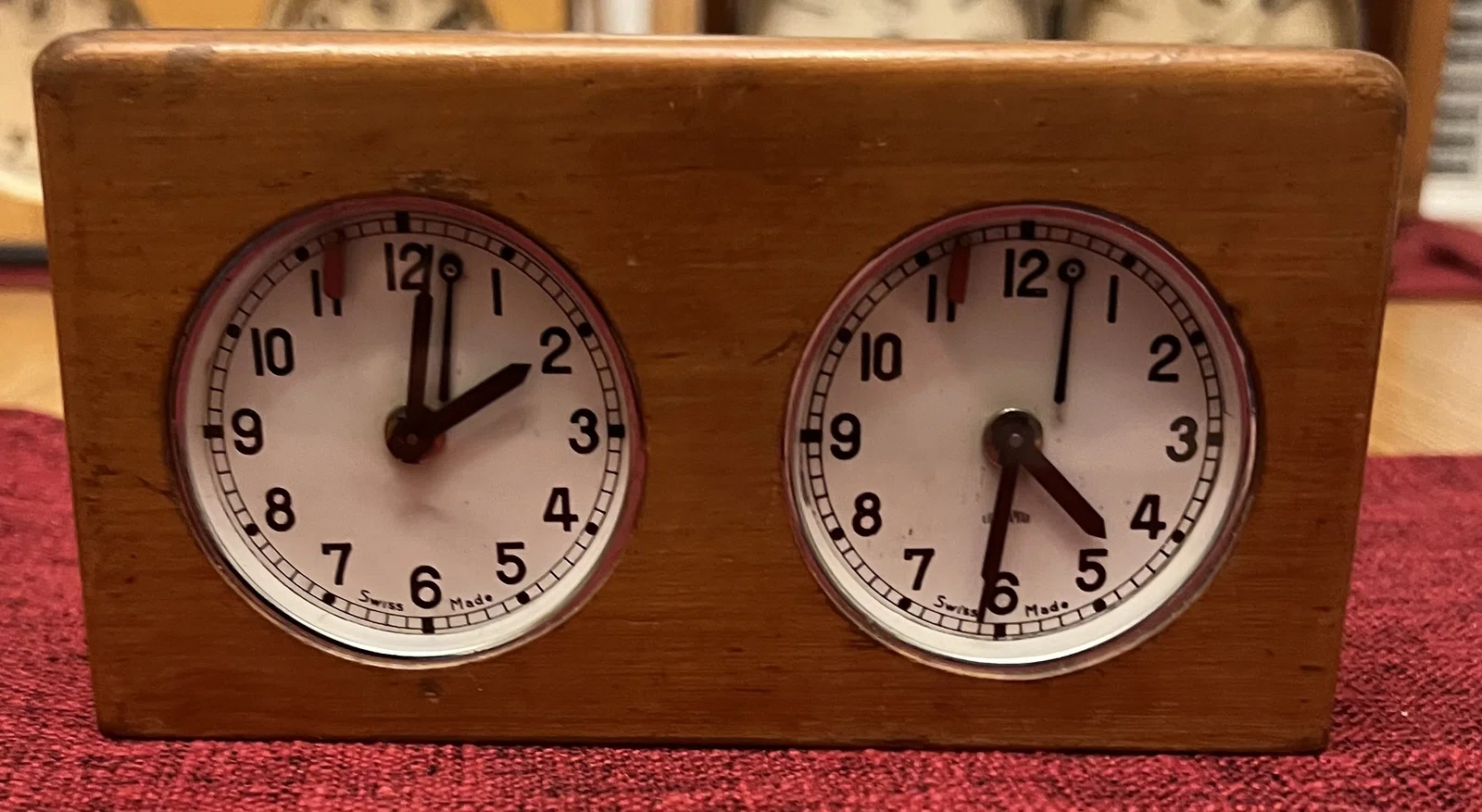
Birse / Grob's Schachuhr
A compact postwar Swiss tournament clock whose jeweled movements carried Swiss precision into international competition.
Read the History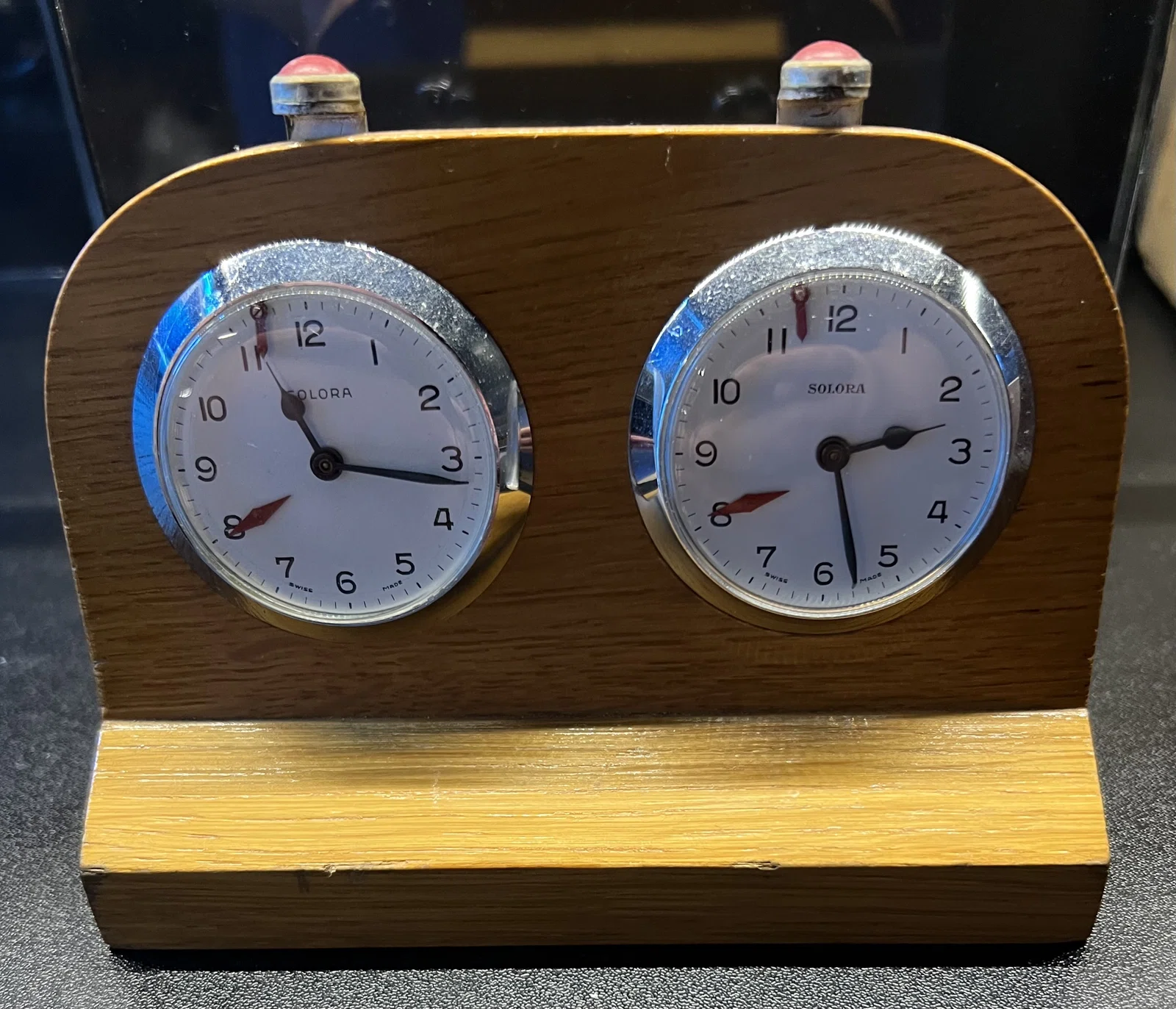
Solora
A miniature Swiss chess clock that used watch-sized movements to produce a quiet, compact tournament instrument sold internationally.
Read the History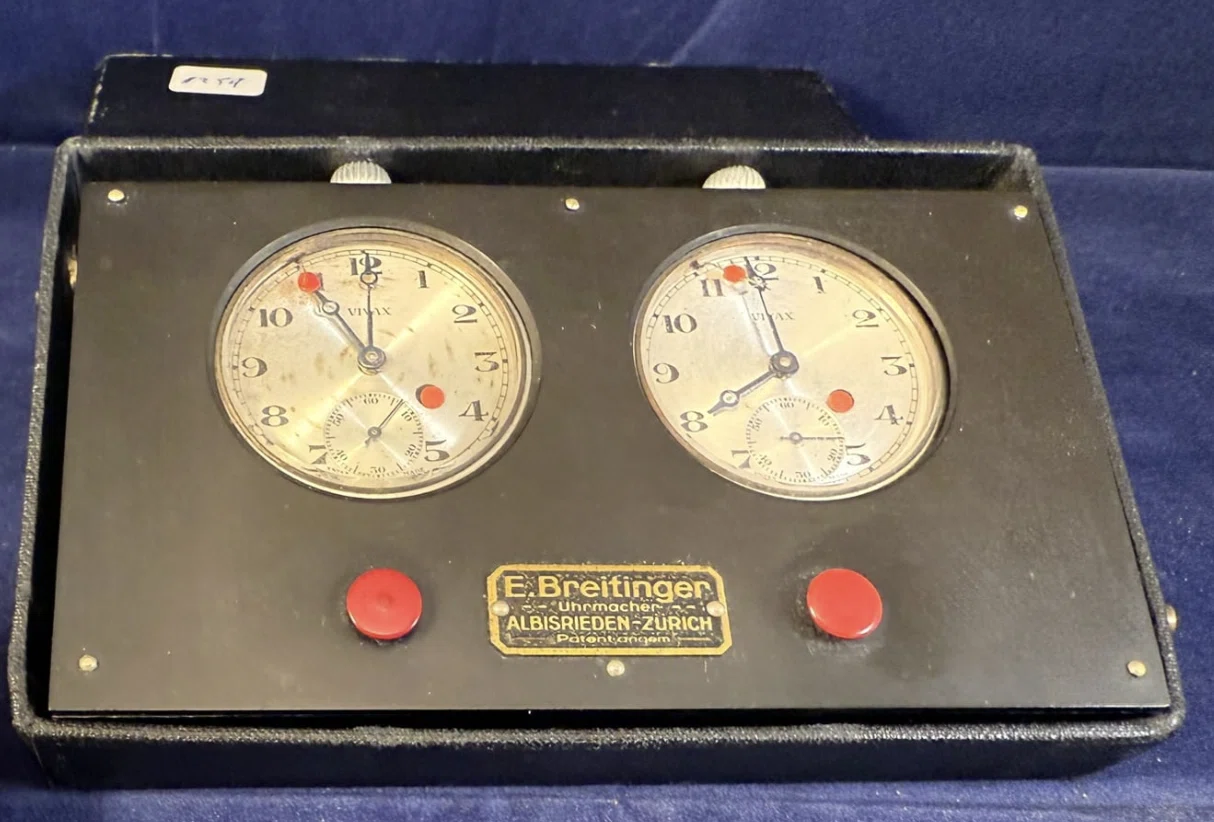
E. Breitinger
A rare Zurich-area watchmaker clock whose patent-pending plaque preserves evidence of local Swiss experimentation outside the better-documented commercial brands.
Read the History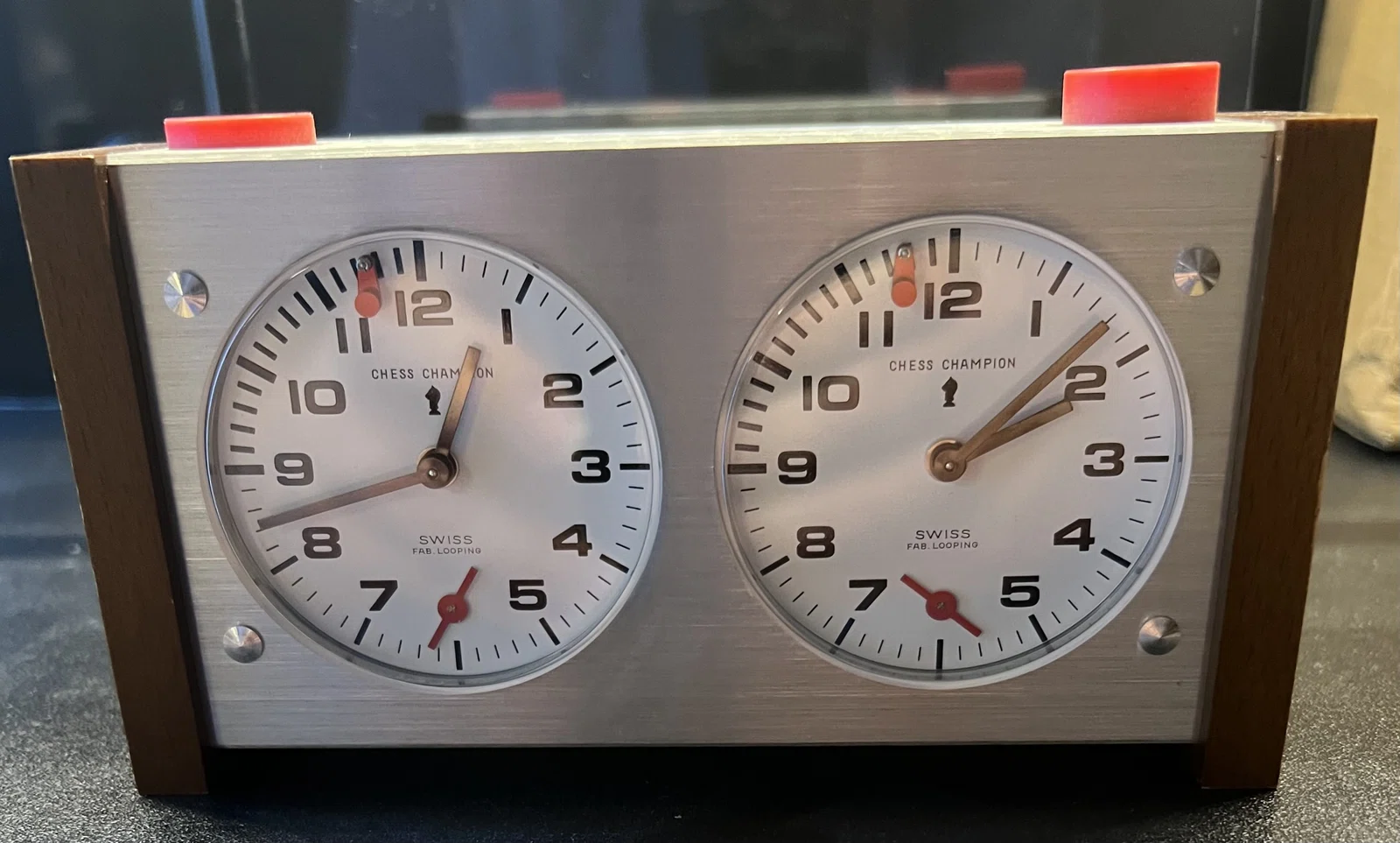
Heuer / Looping
Looping manufactured the clock; Heuer supplied the prestige, distribution, and service network that turned it into one of the most refined mechanical chess timers of its era.
Read the History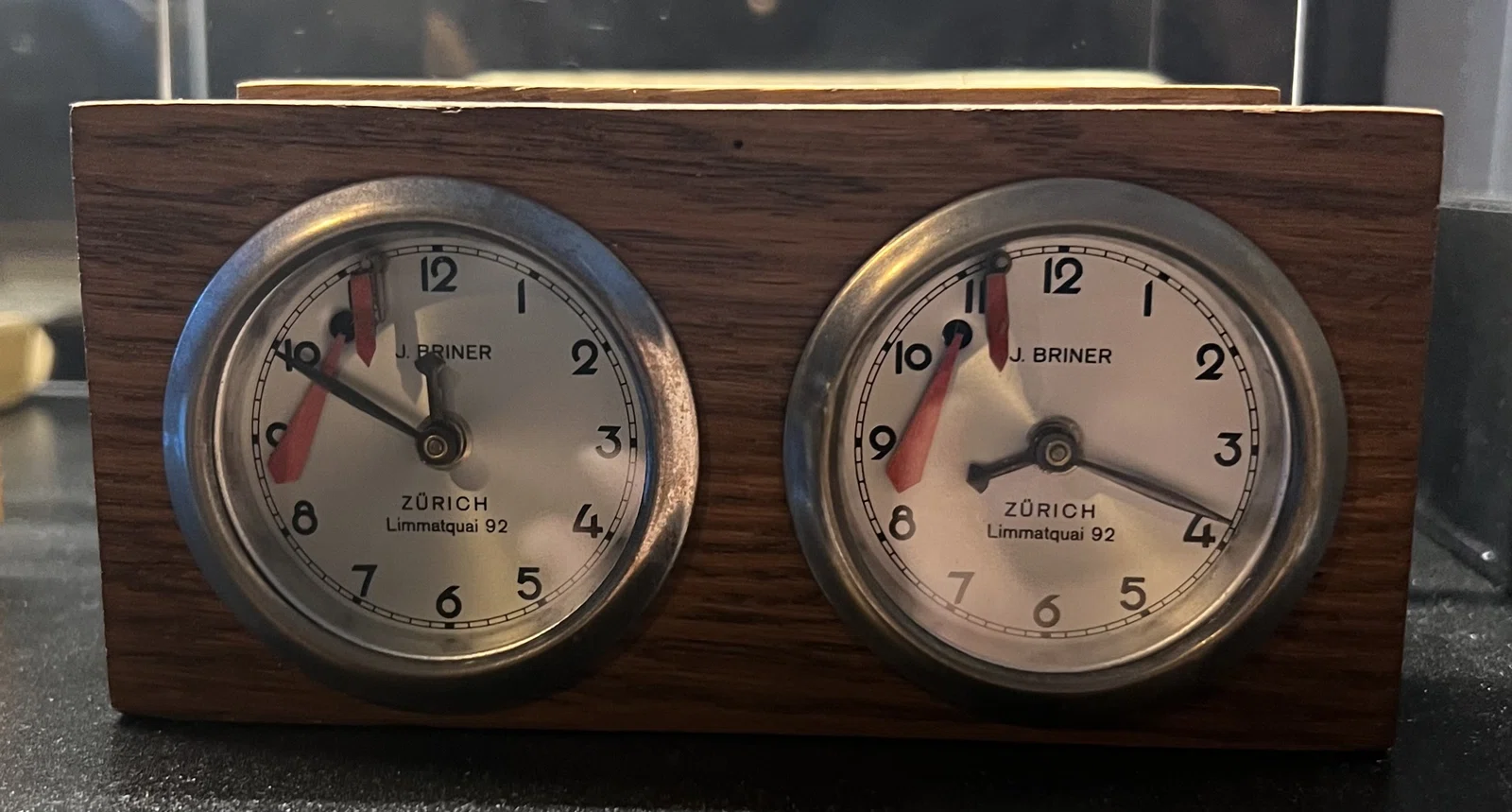
J. Briner, Zürich
A specialist chess supplier whose name on the dial identifies the commercial route to the player more securely than it identifies the factory that made the clock.
Read the History