
Before the Soviet System
Chess had deep roots in Russia long before the Soviet state. By the nineteenth century it was firmly embedded in the urban culture of St. Petersburg and Moscow, while Mikhail Chigorin helped build a Russian tradition of organized competition, chess journalism, and systematic study. Major St. Petersburg tournaments in 1909 and 1914 placed Russia on the international chess map, although serious play remained concentrated among urban intellectuals and elites.
Chess in Russia Before 1925
Moscow 1925 and Chess as a State Project
The Moscow tournament of 1925 transformed the scale and visibility of Soviet chess. Capablanca, Lasker, Marshall, Réti, Rubinstein, Bogoljubov and other leading masters appeared before a huge domestic audience. Newspapers followed the event closely, popular culture absorbed it, and the Soviet state increasingly treated chess as an educational and ideological asset. Under figures such as Nikolai Krylenko, chess spread through workers' clubs, factories, military organizations, schools, youth programs, publications, and state tournaments.
Illustrated record
From Participation to Dominance
The system ultimately produced extraordinary competitive depth. Botvinnik's 1948 world title began a period in which every undisputed world champion through 1972 was Soviet, and the USSR won every open Olympiad it entered from 1952 through 1974. Chess was now a mass cultural institution and a source of international prestige. That institutional density created enormous demand for durable, standardized timing equipment.
Soviet Dominance in World Chess
Cheap Chess Clocks — a Soviet Bottleneck in 1929
A 1929 Soviet article argued that the spread of clocked play was being limited by the price of the clocks themselves. Chess had moved beyond championships into club and mass tournaments, but timing equipment remained expensive enough to absorb much of a local club's operating budget.
Translation from 64, 1929, no. 6. Source 474.
- Pair of chess clocks
- 23–28 rubles
- Many clubs' six-month budget
- 20–30 rubles
- Mass-production target
- 7–8 rubles
A single pair of clocks could therefore consume nearly an entire six-month club budget. The article treated affordability as an infrastructure problem, not merely a lack of enthusiasm.
The proposed solution was large-scale state or cooperative production, especially for the provinces, with a target price of 7–8 rubles per pair.
The evidence makes cheap, standardized timing devices part of the infrastructure required for Soviet mass chess. 474
Building Soviet Horology
The clock industry that supplied this demand was itself a state industrialization project. In 1930 the First State Watch Factory was established in Moscow using machinery, tooling, and designs purchased from American firms including Dueber-Hampden and Ansonia. American technicians helped train workers, while German watchmakers from Ruhla and Glashütte also contributed expertise. Wartime evacuation preserved key capacity, and postwar expansion created a network of specialized factories producing watches, alarm clocks, industrial timers, and specialized instruments.
Illustrated record
From Transitional Clocks to a Soviet Standard
Early Soviet chess clocks still show Central European influence in their wooden cases, dial arrangements, and mechanical vocabulary. A 1930s Leningrad form can reasonably be described as a 'proto-Jantar': rectangular wood case, exposed plungers, symmetrical dials, and an emphasis on durability and readability. By the mid-twentieth century, clocks associated with Moscow and Orel factories had converged on a stable tournament architecture.
Illustrated record
The Jantar Family
The Jantar lineage became the defining Soviet mechanical chess clock. Wooden models gave way during the 1960s to molded Bakelite forms and then, from the early 1970s, to lightweight plastic production at the Orel Watch Factory. The plastic Jantar became ubiquitous across Soviet and post-Soviet chess and was exported under names including Corsar, VEGA, Monroe, and Marathon. The brand could change for the market; the underlying Soviet tournament architecture remained recognizable.
Illustrated record
Beyond Jantar
Jantar dominated the visual memory of Soviet chess timing, but it was not the only path. Slava, the principal brand of the Second Moscow Watch Factory, also produced specialized chess clocks by adapting consumer alarm-clock mechanics. A rare export clock marked 'SLAVA,' '11 JEWELS,' and 'MADE IN USSR' demonstrates how the wider state horological system could generate chess timers outside the Jantar family.
Slava – A Rare Soviet Alternative to Jantar
Historical Sequence
The Soviet story is therefore one of institutional scale meeting industrial scale. A mass chess system required huge quantities of dependable equipment; a state horological network could supply it. Early regional and foreign-influenced forms converged into standardized state products, culminating in Jantar's enormous reach while leaving room for less familiar factory alternatives such as Slava.
Explore this national record
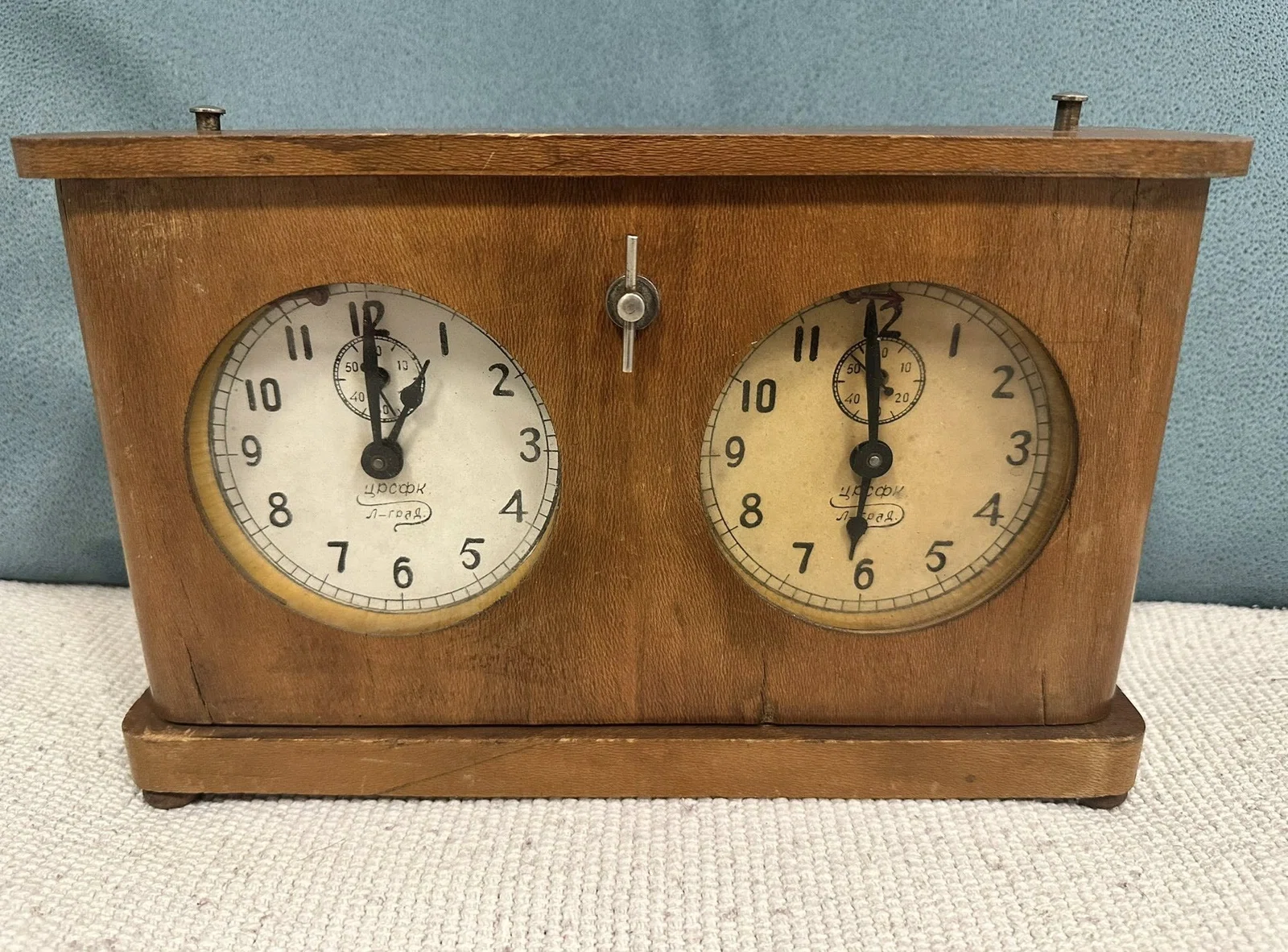
Proto-Jantar
A 1930s Leningrad clock that appears to anticipate the shape, controls, and tournament priorities of the later Soviet Jantar family.
Read the History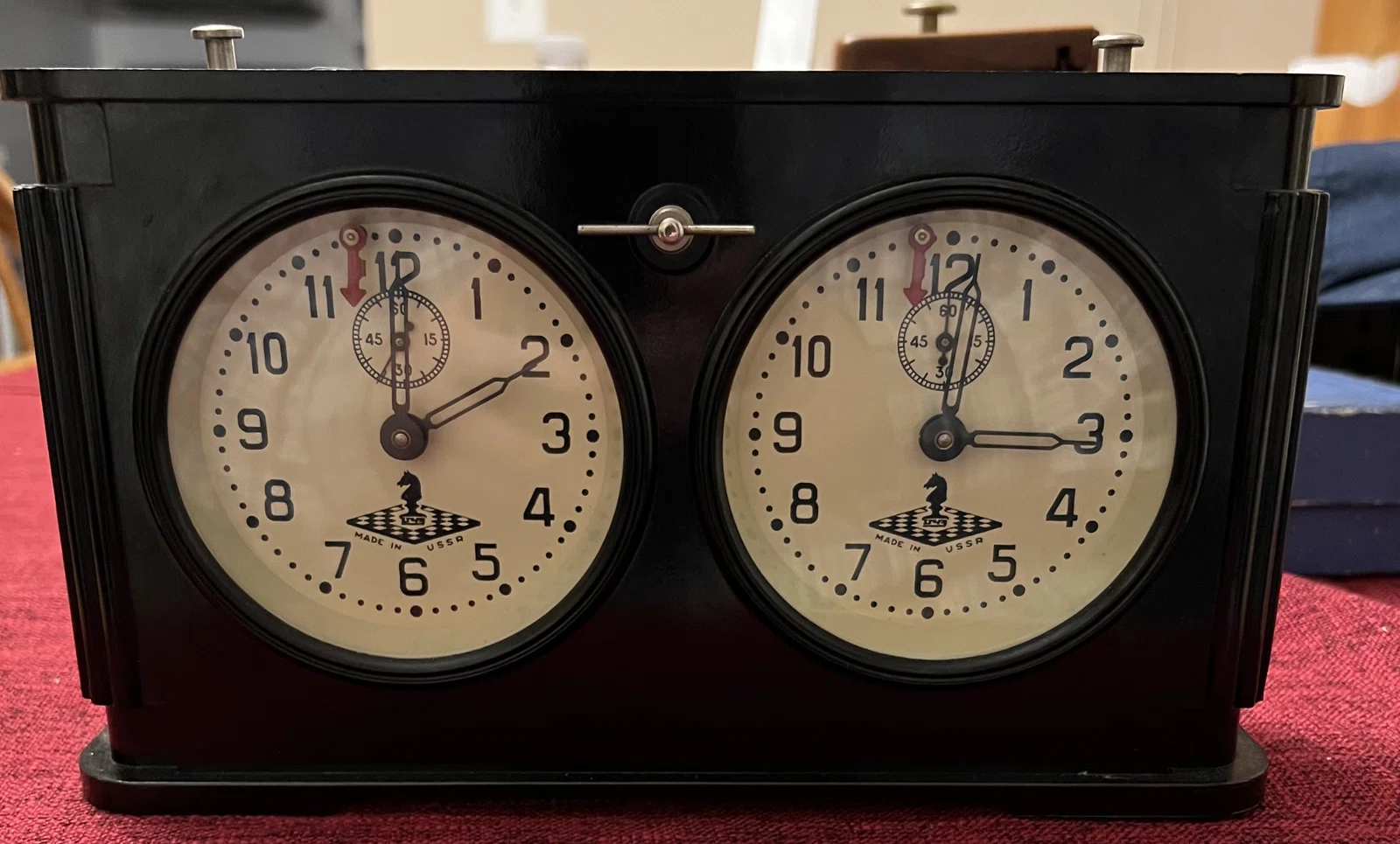
Jantar
The Soviet Union's most influential mechanical tournament-clock family, evolving from standardized wooden production through Bakelite to globally exported plastic clocks.
Read the History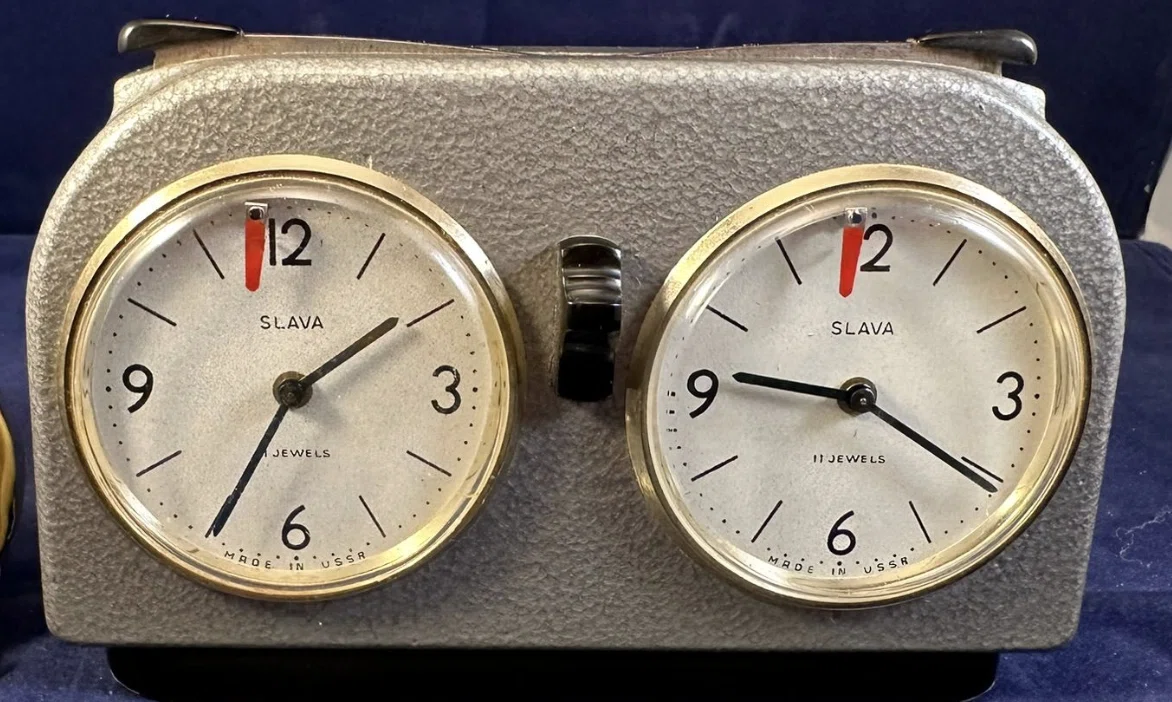
Slava
A rare Soviet alternative that adapted standardized Slava alarm-clock technology to a specialized metal chess-clock case.
Read the History