
A Chess Culture Ready for Timed Competition
Germany's importance to chess-clock history begins on the demand side. The historical record traces German chess culture back through centuries of chess-piece production and, by the nineteenth century, a rapidly developing chess press. The Deutsche Schachzeitung began publication in 1846 and helped create a shared audience for serious chess before a national federation existed. Journalism, analysis, and a growing literary culture gave German chess an intellectual infrastructure that could later support clubs, congresses, and tournament play.
National organization followed. The German Chess Federation was founded in Leipzig in 1877. The surviving record documents growth from 58 clubs in 1879 to 83 in 1883, 182 by 1914, and 230 by 1922. Individual membership also expanded, from roughly 2,500 in 1887 to around 5,000 by 1914 and perhaps 18,000–20,000 by 1923. Emanuel Lasker's world-championship reign from 1894 to 1921 gave the country additional international prestige, while Weimar-era Berlin supported a chess culture extending well beyond formal clubs into cafés, restaurants, exhibitions, lectures, and master appearances.
That combination mattered because a chess-clock industry needs more than clockmakers. It needs organized chess dense enough to create recurring demand for standardized timing equipment. Germany increasingly had both.
Illustrated record
The Black Forest Before the Factory
Germany also possessed one of Europe's deepest clockmaking traditions. In the Black Forest, clockmaking began as a rural household craft in the late seventeenth century. Abundant wood, long winters, dispersed villages, and skilled domestic labor helped make clock production a natural supplementary industry.
The historical evidence shows that these clocks were never merely local products. Between 1700 and 1800, Black Forest makers exported roughly one million wooden clocks. By about 1840, the region contained around 1,000 clockmaker workshops, employed approximately 5,000 workers, and produced about 600,000 wooden clocks per year. In 1850, a clockmaking school opened in Furtwangen to improve technical training, design, and production standards.
This older workshop economy created the reservoir of knowledge from which later factories could draw. The German chess clock would eventually become an industrial product, but that industrialization rested on generations of regional mechanical skill.
Illustrated record
From Workshop District to Industrial Giant
After 1850, the structure of German clockmaking changed rapidly. Factories began to replace parts of the older home-workshop system, and practical products such as alarm clocks, wall clocks, table clocks, and regulators were well suited to standardized manufacturing.
The scale of the transformation was enormous. The surviving record gives Black Forest output at about 1.8 million clocks in 1870 and roughly 5.8 million by 1905. By 1905, the region reportedly accounted for about half of all large clocks exported worldwide. Junghans became the clearest symbol of this industrial turn. Founded in Schramberg in 1861, it had grown into the world's largest watch and clock factory by 1903, with more than 3,000 employees and production exceeding three million timepieces per year.
This industrial base gave German chess-clock production an advantage that few countries could match: experienced mechanical labor, standardized movements, factory-built cases, export channels, and companies already accustomed to producing millions of ordinary timekeepers. A chess clock no longer needed to be imagined as a complete bespoke instrument. It could increasingly be assembled from components produced inside a vast industrial ecosystem.
Illustrated record
Early German Chess Clocks: Factory Skill Meets a New Device
The available evidence places Thomas Haller among the earliest German firms associated with the dual-movement chess-clock architecture. That association begins with a substantial Schwenningen clockmaker, not with Junghans. Haller's trademark for large clocks was registered in 1890, and the surviving industrial record places American-system movement construction in the Schwenningen context by 1889. By 1899, Haller's pocket-watch output was reported at roughly 4,000 per day.
A surviving chess clock attributed as “probably by Thomas Haller” and dated around 1890/1900 uses two independent movements joined by a central rocker mechanism. A Hedewig / Leipzig connection places the object inside organized chess-equipment distribution. The attribution should remain cautious, but the clock is important evidence of early German factory adoption of a timing architecture made practical in Britain only a few years earlier.
The post-1900 history is more complicated than a simple Haller-to-Junghans succession. In 1900 the businesses were combined under the Junghans–Haller corporate name. The newer evidence reports an operational separation in 1902, even though combined Junghans–Thomas Haller catalogs continued afterward and the Haller name remained in the Junghans legal title until 1911. The cleanest interpretation is therefore that 1902 marks the operational break, while 1911 marks the formal Junghans corporate-name break.
At the same time, a separate Thomas Ernst Haller AG was founded in 1902 after the Junghans dispute, and Thomas Haller joined his son's concern in 1904. This creates two post-1900 tracks: the temporary Junghans–Haller corporate identity and an independent Haller-family line operating alongside it.
A surviving chess clock dating to about the 1920s strengthens that distinction. Its H-in-triangle mark is assigned in the horological trademark record to Thomas-Ernst Haller AG of Schwenningen, tying the clock to the independent post-1902 branch. The object therefore pushes Haller chess-clock history beyond the early rocker clock and into the 1920s. In 1928, Thomas Ernst Haller AG merged with Kienzle to form Kienzle-Haller AG.
Illustrated record
Junghans Turns the Chess Clock into a Catalog Product
Junghans illustrates what industrial scale could do once the chess clock had become an established piece of tournament equipment. The company did not merely supply generic movements. By 1915 it was cataloging a “Schach-Uhr / Horloge d'Echec” directly, and a 1932–34 listing identified model number, dimensions, running duration, case material, price, and operating instructions.
That level of documentation marks an important change. The chess clock could now be ordered as an ordinary catalog product from one of the world's largest clock companies. A 1917 chess-periodical advertisement placed Junghans clocks directly inside the chess market, while clocks of the same general type appear in serious European play during the 1920s.
Junghans also influenced clocks that did not carry its name. Surviving documentation records imported Junghans A32 and B32 units inside a 1932 Casa Alari clock from Buenos Aires and points to Austrian examples using Junghans movements. Germany was therefore exporting both finished chess clocks and the mechanical building blocks from which other countries could create their own.
The revised Haller chronology sharpens that interpretation. Junghans remains the scale-and-distribution story, but the 1902 operational split means the later Thomas Ernst Haller branch should not be folded entirely into Junghans. The two histories overlap after 1900 without becoming identical.
Illustrated record
HAC: Component Industrialization and International Circulation
The Hamburg American Clock Company’s chess-clock importance begins with industrial movement production rather than invention. The company began as Landenberger & Lang in 1875, took the Hamburg-Amerikanische Uhrenfabrik name in 1883, adopted the crossed-arrows mark in 1891, transferred its seat to Schramberg in 1901, entered an association with Junghans and Vereinigte Freiburger Uhrenfabriken in 1926, and was ultimately combined into Junghans. 475 476 477
For chess clocks, HAC demonstrates how the mechanical core could be separated from final assembly. Surviving finished HAC-type clocks, rear views showing two independent movements, and crossed-arrows markings make that industrial role visible. 478 479 480
A 1925/26 Jaques price list adds a particularly clear retail link: it lists an HAC-type chess clock at 30 shillings and a separate Jaques Congress Timer at 70 shillings. The evidence shows an HAC-type product moving through British retail channels while remaining distinct from Jaques’ premium Congress model. 481
HAC therefore sits at the center of a broader supply-chain story: German movements could pass through export and wholesale networks, enter locally made cases, receive another seller’s branding, and reach players in a different national market. 482
Industry and Workshop Production Coexist
German industrialization did not eliminate small-scale makers. Paul Posingis is the clearest counterexample in the surviving record. Working from a small workshop in a colliery house near Hamm, Posingis began building chess clocks in the early 1930s because existing products were large, expensive, and difficult to obtain during the Depression. His clocks remained handmade and used movements from a single outside supplier.
Posingis did not represent a retreat from industrialization. He represents coexistence. Large factories and small workshops could serve different portions of the same market. Industrial firms were able to produce standardized clocks and movements at scale, while local craftsmen could still succeed by solving specific problems of cost, size, accessibility, or design.
Jerger similarly demonstrates that by the mid-twentieth century chess clocks could simply become one recurring line inside a broader clock company. The device no longer needed to be reinvented. A manufacturer could retain the standard dual-movement architecture while varying controls, decoration, materials, and target markets.
Illustrated record
The Postwar Divide: West German Diversity and East German Scale
After the Second World War, German chess-clock production developed inside two very different economic systems. In the West, makers and brands such as Jerger, BHB, Fichter, Alpha, Blessing, and Bohemia occupied different points along a spectrum from workshop manufacture to large consumer-clock factories and specialist chess-equipment distribution.
In the East, the Ruhla production base became part of the DDR's centralized industrial structure. Friedrich Schildt's 1951 design, built around modified alarm-clock movements, developed into a long-running production family associated with Thiel, Ruhla, and later Gardé. The first 150 clocks were supplied for the 1951 World Festival in Berlin. Successive redesigns in 1954 and 1961 moved the clock toward the mature form that would remain in production for decades.
The contrast is instructive. West German chess clocks show a diverse market of firms, workshops, brands, and distributors. Ruhla/Gardé shows a centralized, state-scale program with broad exports. Both systems produced durable tournament equipment, but they did so through very different industrial organizations.
Illustrated record
The Mature Mechanical Club Clock
By the later twentieth century, companies such as BHB reveal a market in which the mechanical chess clock had stopped changing fundamentally. The basic architecture was settled. Manufacturers instead optimized size, durability, cost, materials, and specialized tournament features.
BHB moved from wooden cases to bakelite and plastic. Alpha retained the standard format while producing targeted blitz and buzzer variants. Fichter offered a compact, high-quality West German clock even as quartz technology and cheaper East German products increased pressure on traditional mechanical firms. Bohemia sold clocks as a chess-equipment brand while outsourcing the Bohemia 551 to the large West German manufacturer Blessing.
The chess clock had become an everyday tool. Its story was increasingly commercial rather than inventive: who could make it cheaply, distribute it widely, adapt it to tournament needs, or keep it relevant as electronic timing approached.
Illustrated record
Germany as a Global Mechanical Hub
Across the full German section, one theme repeatedly appears: Germany functioned not only as a national producer but as an international mechanical hub. Haller and Junghans supplied complete clocks. Junghans and HAC supplied movements and clock units. German mechanisms appeared inside clocks assembled in Britain, Austria, Argentina, the Netherlands, Sweden, and elsewhere. West German brands could outsource to other German factories, while East German Gardé clocks were exported around the world.
This is why national labels alone are often inadequate for chess clocks. A Dutch-market Basch clock could contain German Gebrüder Hauser movements. A British Tanner clock could contain HAC mechanisms. A Bohemia-branded West German product could be manufactured by Blessing. Germany's real historical footprint lies in this network of manufacturing relationships as much as in any individual brand.
Illustrated record
A German Historical Sequence
The German chess-clock story can be read as a sequence of industrial roles. Thomas Haller represents both early factory adoption and, through the post-1902 Thomas Ernst Haller branch, documented continuity into the 1920s. Junghans represents scale, catalog standardization, and international circulation. HAC represents modular component production. Philipp Haas & Söhne shows a major Black Forest factory entering a specialized niche. Posingis preserves the viability of workshop production alongside industry. Jerger and Alpha demonstrate long-term continuity. Ruhla/Gardé represents centralized state-scale production. BHB shows the mature mechanical club era. Bohemia and Blessing separate branding from manufacture. Fichter belongs to the final generation of premium West German mechanical clockmakers before the old industry came under severe pressure.
Together, these clocks explain why Germany became one of the central countries in the history of chess timing. The country did not invent the practical chess clock, but it possessed the manufacturing system capable of standardizing, multiplying, exporting, and mechanically supplying it on a global scale.
Continuity and Competitive Use
Explore this national record
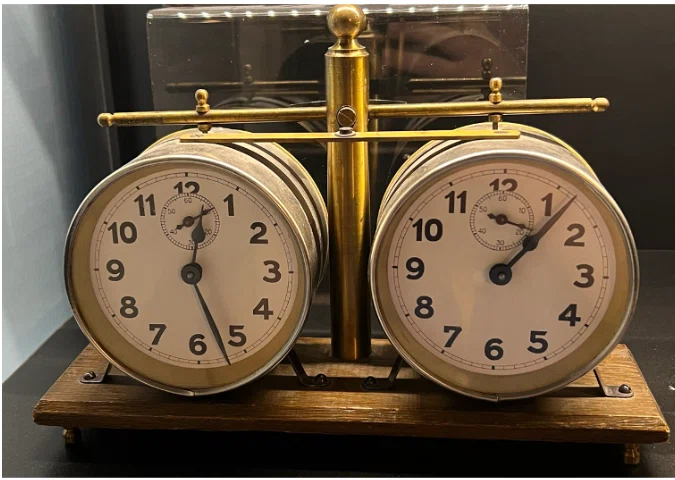
Thomas Haller
A Schwenningen clockmaker whose chess-clock history now resolves into two post-1900 tracks: the Junghans–Haller corporate identity and an independent Thomas Ernst Haller line documented into the 1920s.
Read the History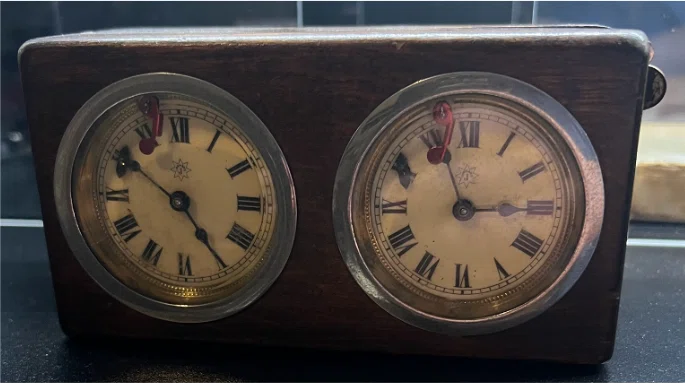
Junghans
Germany's industrial giant turned the chess clock into a documented catalog product while also exporting the mechanical units that allowed other countries to build clocks of their own.
Read the History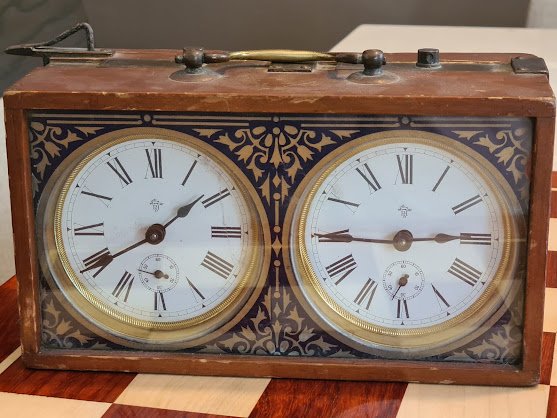
Philipp Haas & Söhne
A rare 1907 chess clock links a major Black Forest industrial maker to a specialized chess-timer niche and preserves an unresolved British patent and provenance trail.
Read the History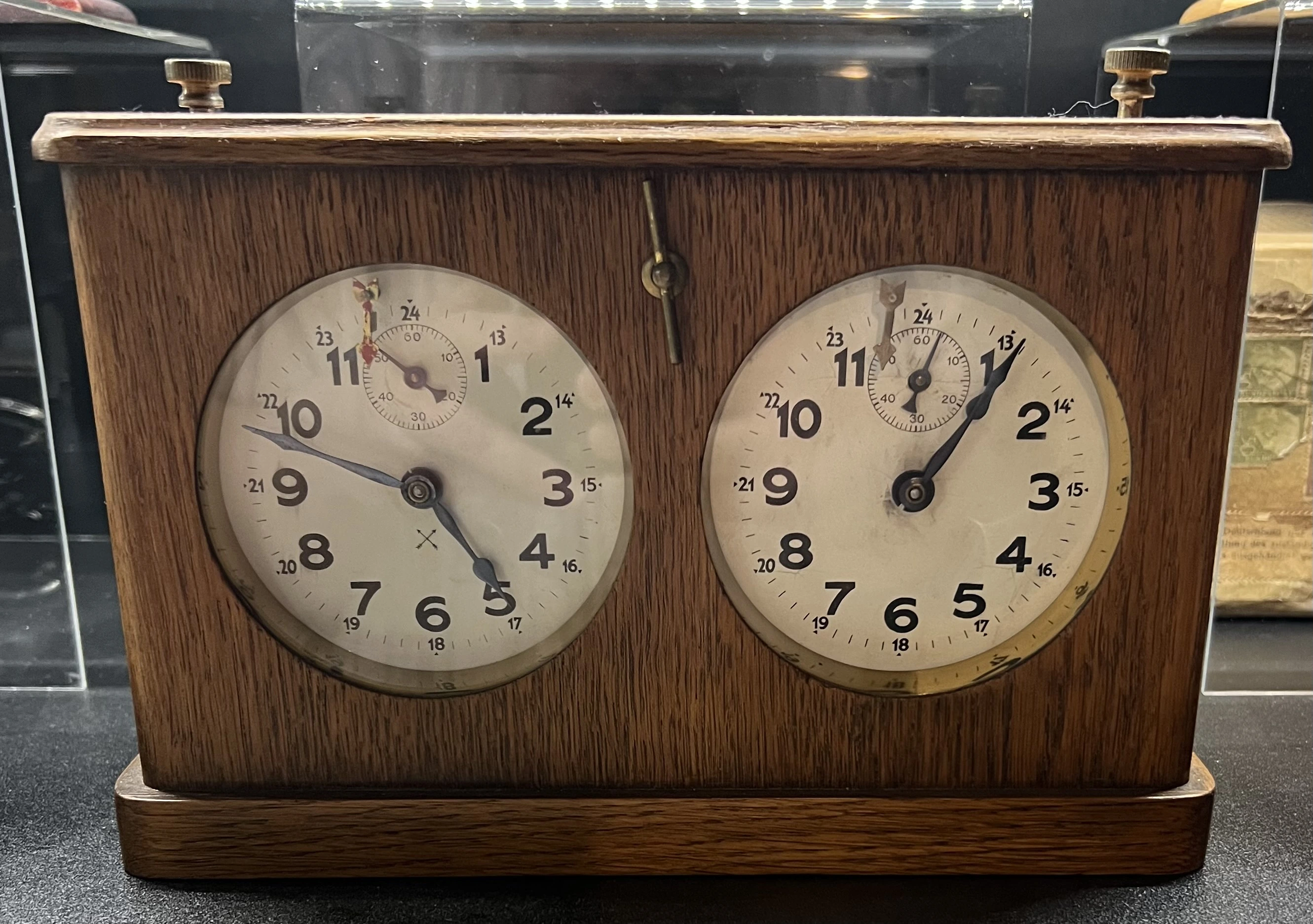
Hamburg American Clock Company (HAC / HAU)
HAC's chess-clock importance begins with industrial movement production, not invention: standardized German mechanical cores that could move through trade, assembly, and retail networks.
Read the History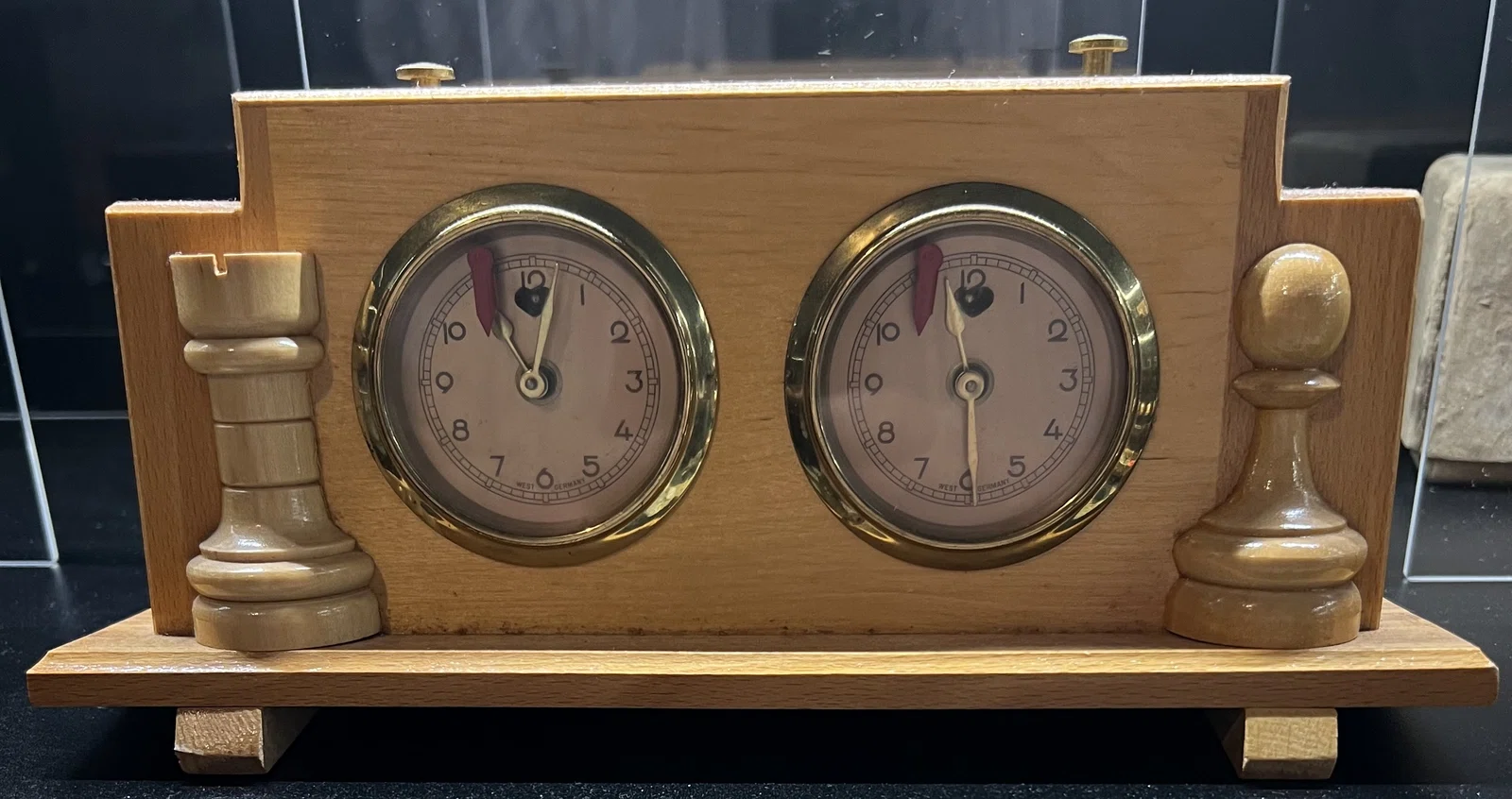
Jerger
A long-running German clockmaker that treated chess clocks as a recurring product line, demonstrating the stability and diversification of the mature mechanical system.
Read the History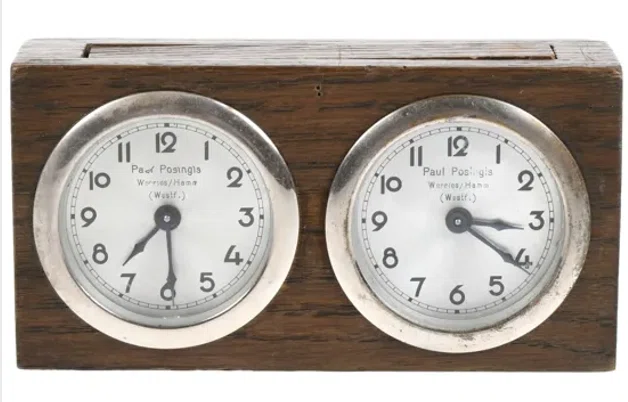
Paul Posingis
A small Westphalian workshop that answered Depression-era cost and availability problems with handmade clocks, proving that workshop production could coexist with German industrial scale.
Read the History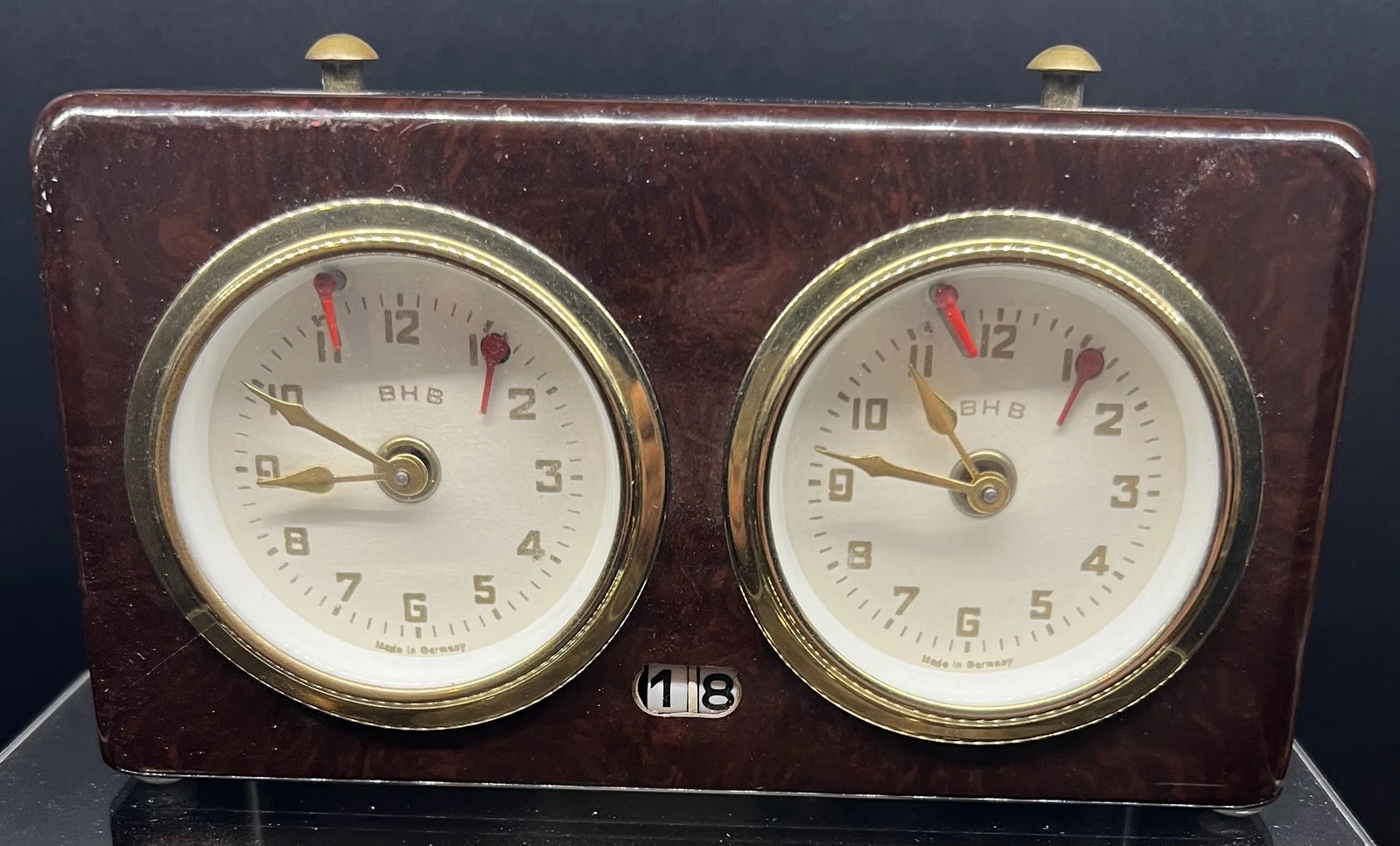
BHB
Bruno Borchert's Hamburg workshop produced the quintessential mature mechanical club clock: compact, durable, inexpensive enough for repeated use, and optimized rather than reinvented.
Read the History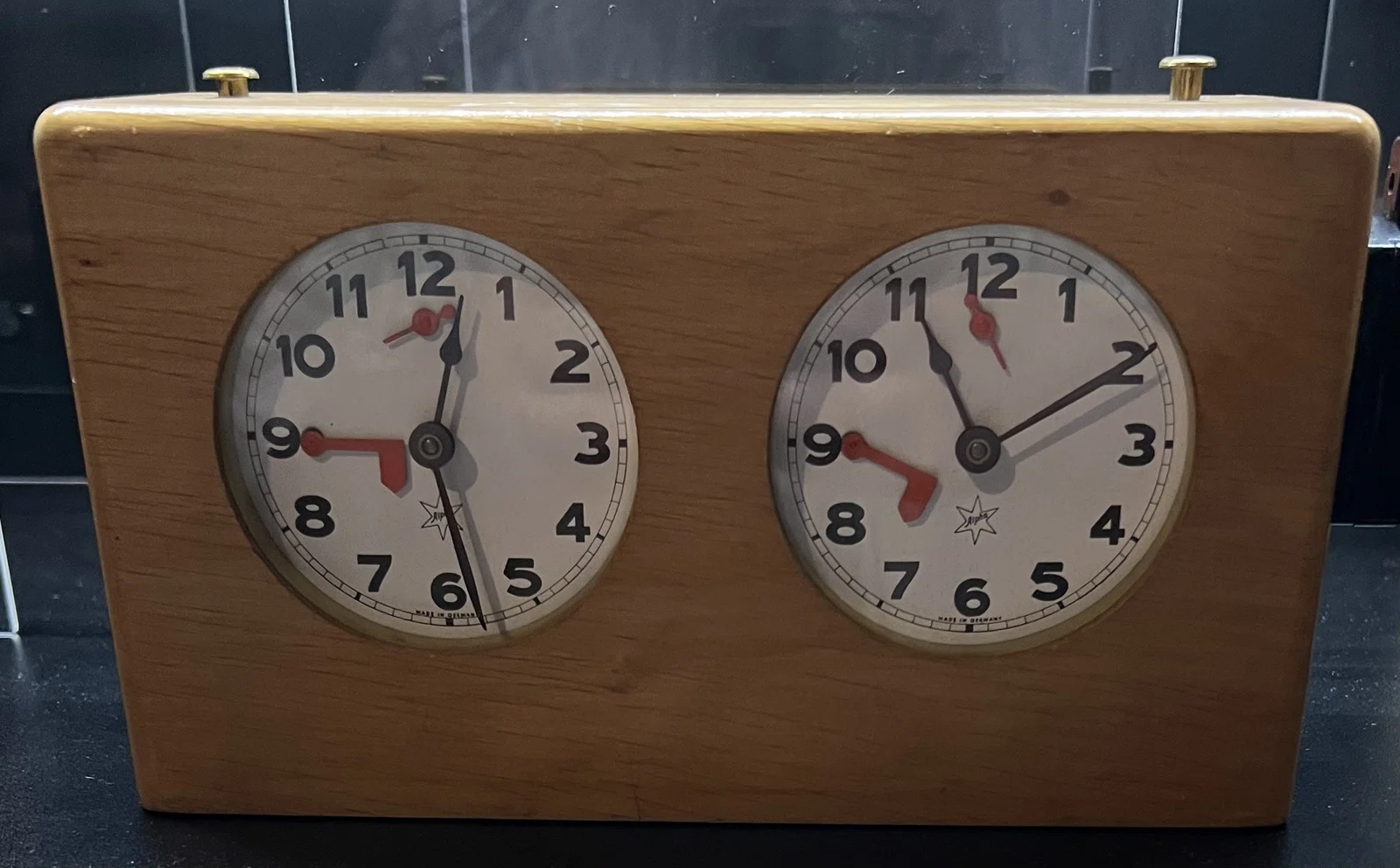
Max Andres / Alpha
A German chess-clock line with documented use across decades of high-level competition, showing how a stable mechanical design could persist while specialized features evolved around it.
Read the History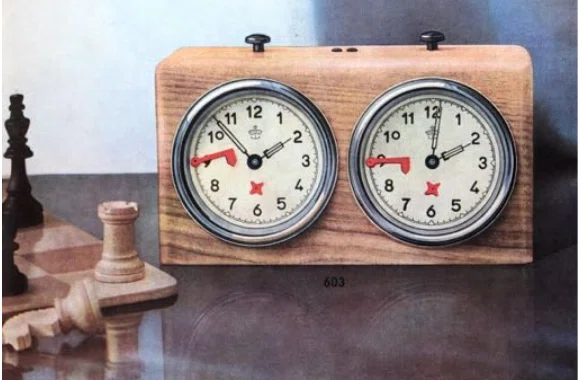
Thiel / Ruhla / Gardé
Friedrich Schildt's 1951 design grew into one of the defining state-scale chess-clock families of postwar East Germany, evolving through documented generations and broad international export.
Read the History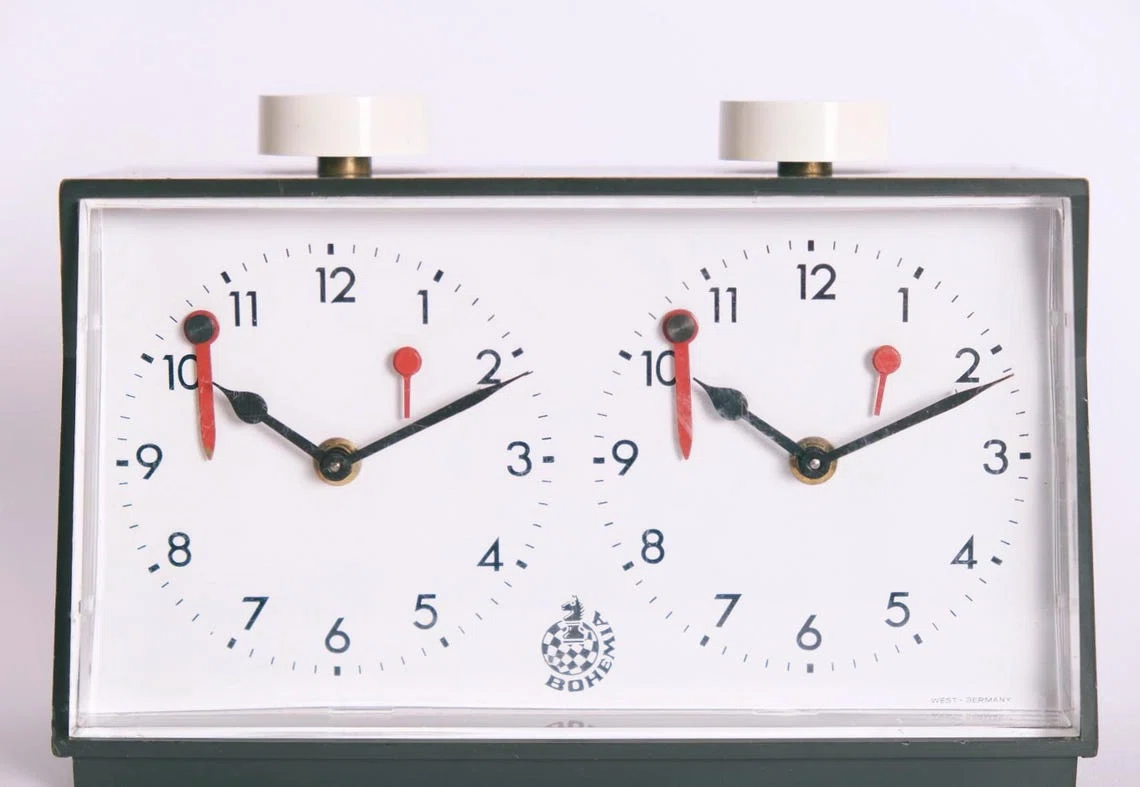
Bohemia / Blessing
The Bohemia 551 separates brand identity from manufacturing origin: a West German chess-equipment brand sold a clock specially manufactured by the much larger Blessing clock works.
Read the History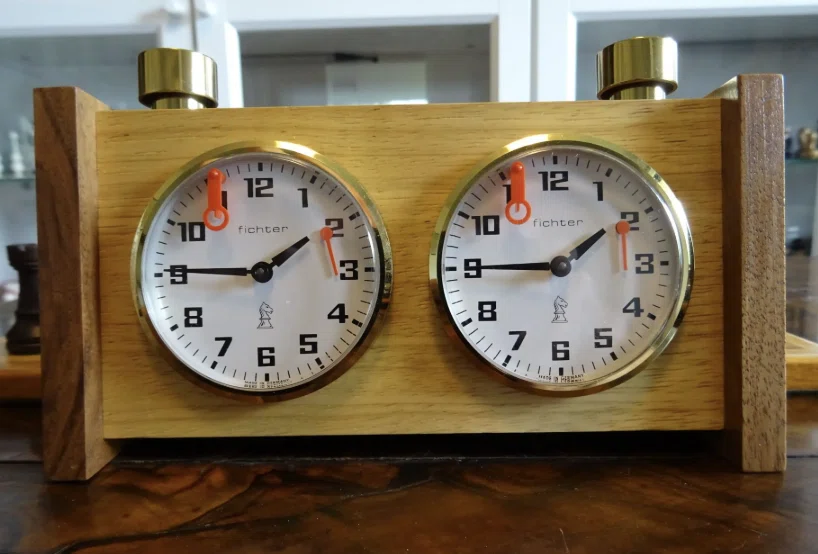
Fichter
A rare late West German mechanical chess clock from a substantial alarm-clock manufacturer caught between traditional horology, East German competition, and the quartz transition.
Read the History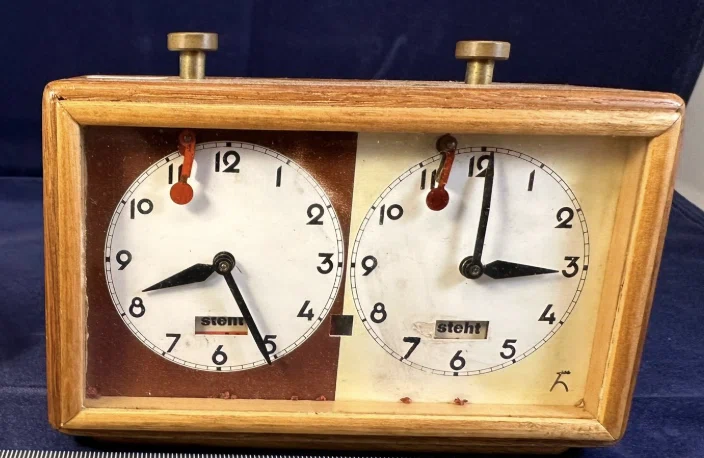
Bschorr
A rare German chess clock whose central planetary mechanism appears to make seconds visible; its plaque, patent-pending mark, and exact mechanical lineage remain unusually difficult to resolve.
Read the History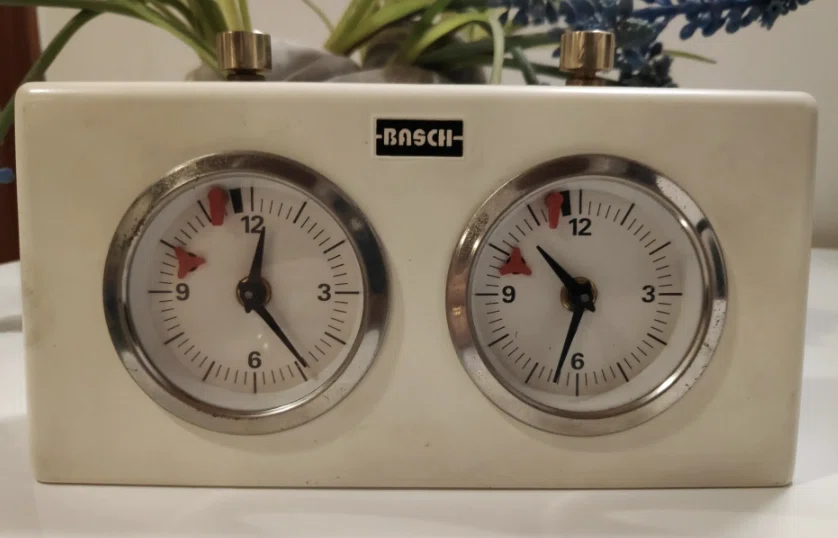
Disputed German-Origin Clocks
Not every clock with German mechanics is a German chess clock. These examples show why national attribution must distinguish the finished object from the movement inside it.
Read the History